
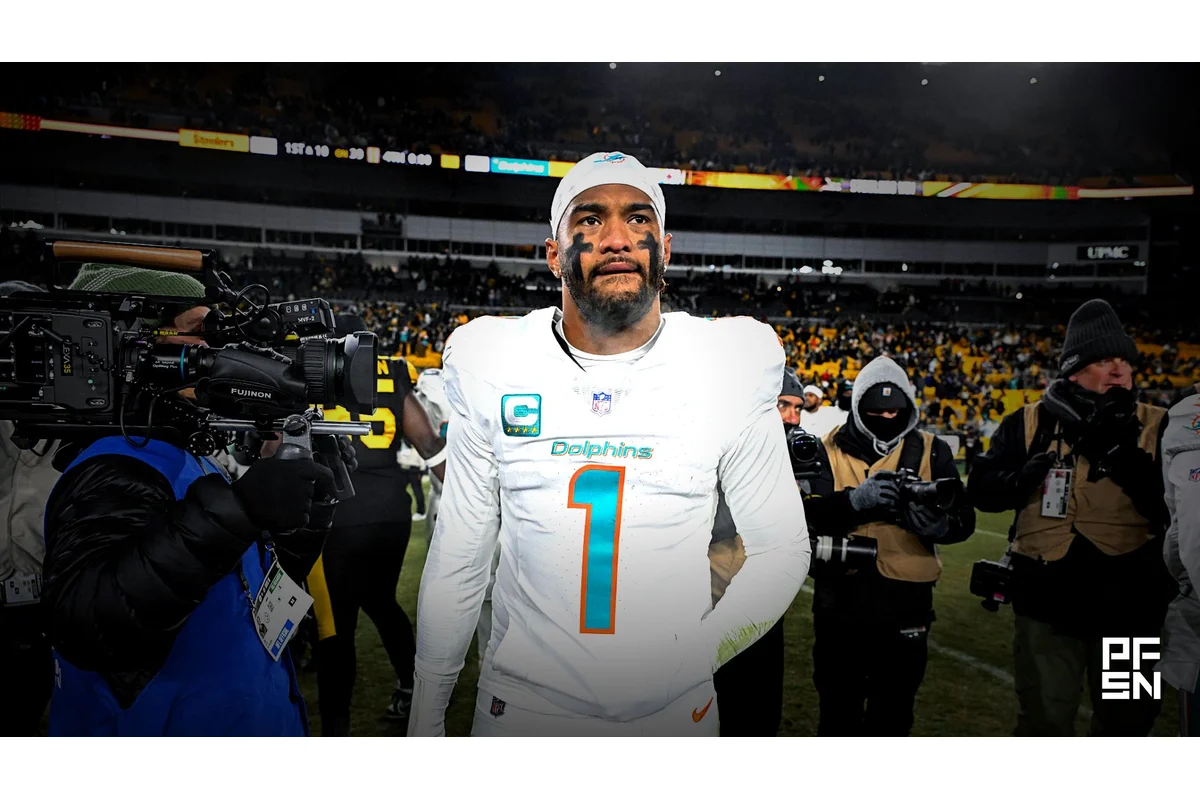
The Miami Dolphins have announced the release of quarterback Tua Tagovailoa with a post-June 1 designation, resulting in an unprecedented $99 million dead cap charge. This decision marks the end of Tagovailoa’s six-season tenure as Miami starts a comprehensive rebuilding process aimed at future success.
General Manager Jon-Eric Sullivan formally confirmed on Monday that the team would part ways with Tagovailoa after the new NFL league year begins. The move reflects Miami’s commitment to restructuring the roster and moving beyond the costly setbacks experienced at quarterback in recent seasons.
Sullivan acknowledged the high regard he holds for Tagovailoa, stating
“great respect for the person and player”
while underlining the franchise’s goal to create a sustained winner. To reset, Miami is willing to absorb the largest dead cap hit for a single player in NFL history, closing a chapter that undermined their last two seasons.
Challenges Forcing Miami Into a Costly Cap Decision
Miami explored all possibilities to avoid this financial burden. At the NFL combine, Sullivan remarked
“everything is on the table, including the potential of a trade,”
yet Tagovailoa’s $54 million fully guaranteed 2026 salary made him untradeable.
This difficult position stems from past management choices. Former GM Chris Grier had negotiated a four-year, $212.4 million contract extension for Tagovailoa in 2024 after an impressive season. However, signs of decline soon emerged. In 2025, Tagovailoa led the league with 15 interceptions over 14 starts and posted a -0.01 EPA (Expected Points Added) per dropback, ranking him in the bottom third of qualified quarterbacks. Head coach McDaniel eventually benched him in favor of seventh-round rookie Quinn Ewers during the final three games.
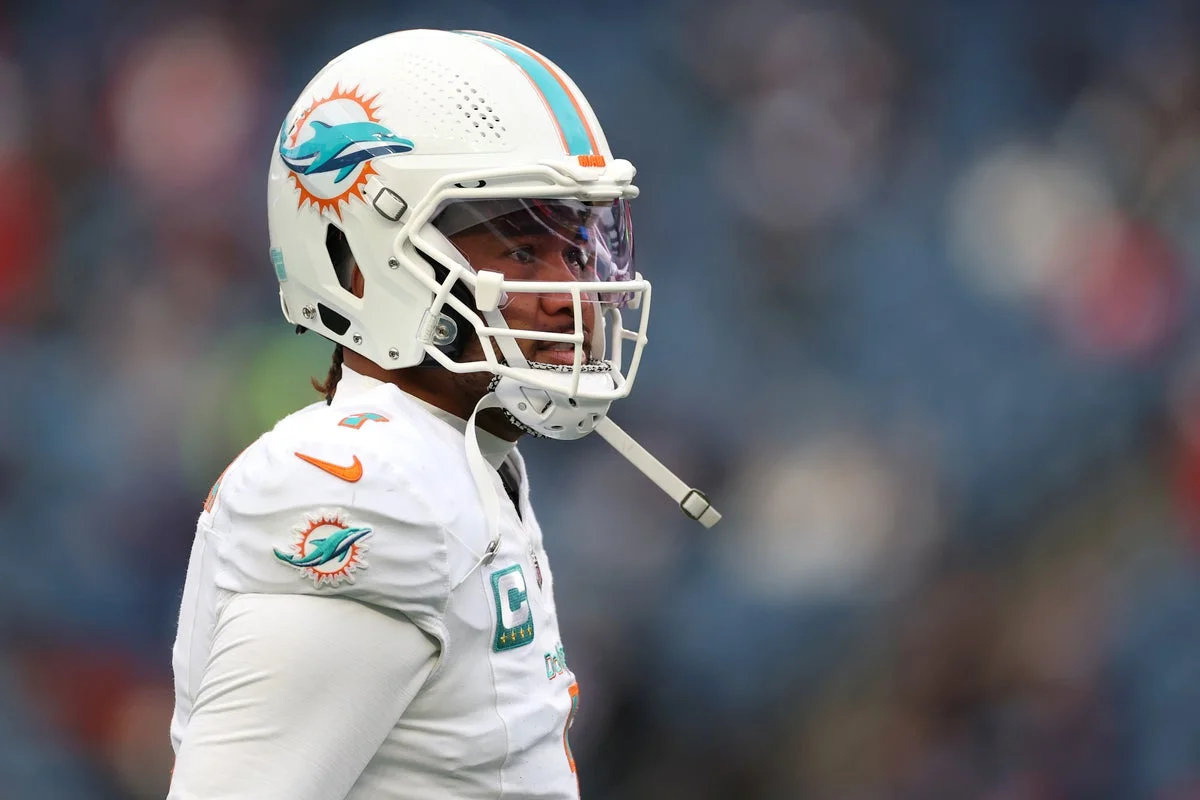
By applying the post-June 1 release designation, Miami is able to distribute the dead cap hit across two seasons. According to OverTheCap, the Dolphins face either $67.4 million in 2026 and $31.8 million in 2027, or $55.4 million this year followed by $43.8 million next season.
This figure surpasses the previous NFL record, previously set when Denver released Russell Wilson.
Tua Tagovailoa’s Decline and Its Impact on Miami’s Future
Tagovailoa’s decreasing performance is clear from PFSN’s QB Impact ratings. Having ranked fifth, eighth, and eighth among NFL quarterbacks from 2022 through 2024—with scores above 80—his rating plunged to 27th in 2025 with a 72.2 QBi, his lowest since his rookie campaign. This rating translated into a drop from a B grade to a C-.
For a quarterback with an annual salary exceeding $53 million, ranking behind 26 other starting signal-callers made continuation untenable. The team’s choice to absorb such a significant cap hit illustrates the drastic measures being taken to move forward.
Applying the Green Bay Model in Miami’s Rebuilding Strategy
Miami’s new leadership, including Sullivan and defensive coordinator Hafley—both from Green Bay—have introduced strategies similar to those that helped the Packers transition from Aaron Rodgers to Jordan Love. Their approach involves focusing on drafting and developing young talent while parting ways with veterans whose costs outweigh their contributions.
However, Miami’s situation lacks the luxury Green Bay enjoyed. Their leading quarterback option remains Quinn Ewers, who completed 65.8% of passes at Texas but was a late pick at 231 overall. Ewers started the final three games of last season but has yet to prove himself as a franchise solution.
Sullivan confirmed plans to draft a quarterback in April and indicated Miami may continue this effort annually. Free agent Malik Willis, familiar with the Packers’ system, is also under consideration. Sullivan stated at the combine,
“I think I’d be lying to you if I said we’re not talking about Malik Willis,”
highlighting his potential as a temporary option.
While Willis might bridge the gap, no clear long-term answer is currently available.
Roster Overhaul Highlights Miami’s Rebuild Commitment
The Dolphins recently released key veterans Tyreek Hill, Bradley Chubb, and James Daniels, freeing significant cap space. These moves underscore that Miami is undergoing a full teardown, not a simple retooling.
The market for Tagovailoa remains limited. ESPN’s Jeremy Fowler reported that the Atlanta Falcons have expressed interest as they await Michael Penix Jr.’s return from ACL surgery. The Minnesota Vikings and New York Jets have also shown curiosity, though likely only for minimal veteran contracts.
The irony is notable: Miami initially tanked in 2019 to secure the fifth overall pick to select Tagovailoa. Six years later, the team faces nearly $100 million in dead money to restart the quarterback search without a premium draft position. This April, the Dolphins hold six picks within the top 111 but none higher than 11th overall.
Long Road Ahead to End Playoff Drought
Miami’s ambition to develop a sustained winner will demand patience the franchise has rarely exhibited over recent decades. The Dolphins have not won a playoff game since 2000. Tagovailoa was expected to break that drought, but his departure signals the beginning of another challenging rebuilding process financed by one of the costliest errors in the franchise’s history.
Dolphins will be able to split Tuas dead money at either
$67.4M/$31.8M
or
$55.4M/$43.8M.
Depends on what they do with an option bonus. My understanding of the rule is they could exercise the option and still use the June 1.
— Jason_OTC (@Jason_OTC) March 9, 2026
Dolphins’ announcement on Tua Tagovailoa: pic.twitter.com/601CMN3T7g
— Adam Schefter (@AdamSchefter) March 9, 2026
