

Following the United States men’s hockey team’s gold medal victory over Canada at the Winter Olympics, Brady Tkachuk found himself at the center of controversy due to an AI-manipulated video shared by the White House. The video falsely portrayed Tkachuk making derogatory remarks about Canada, prompting Tkachuk to publicly distance himself from the content during his visit to Washington, D.C. on Tuesday.
This incident coincided with the U.S. men’s hockey team’s visit to the White House after their historic win in Italy, where tensions between the hockey rivals and the nations remain high. The primary focus of criticism arose from a manipulated clip that did not reflect Tkachuk’s actual words or views.
Background on the Olympic Team and Sibling Contributions in Italy
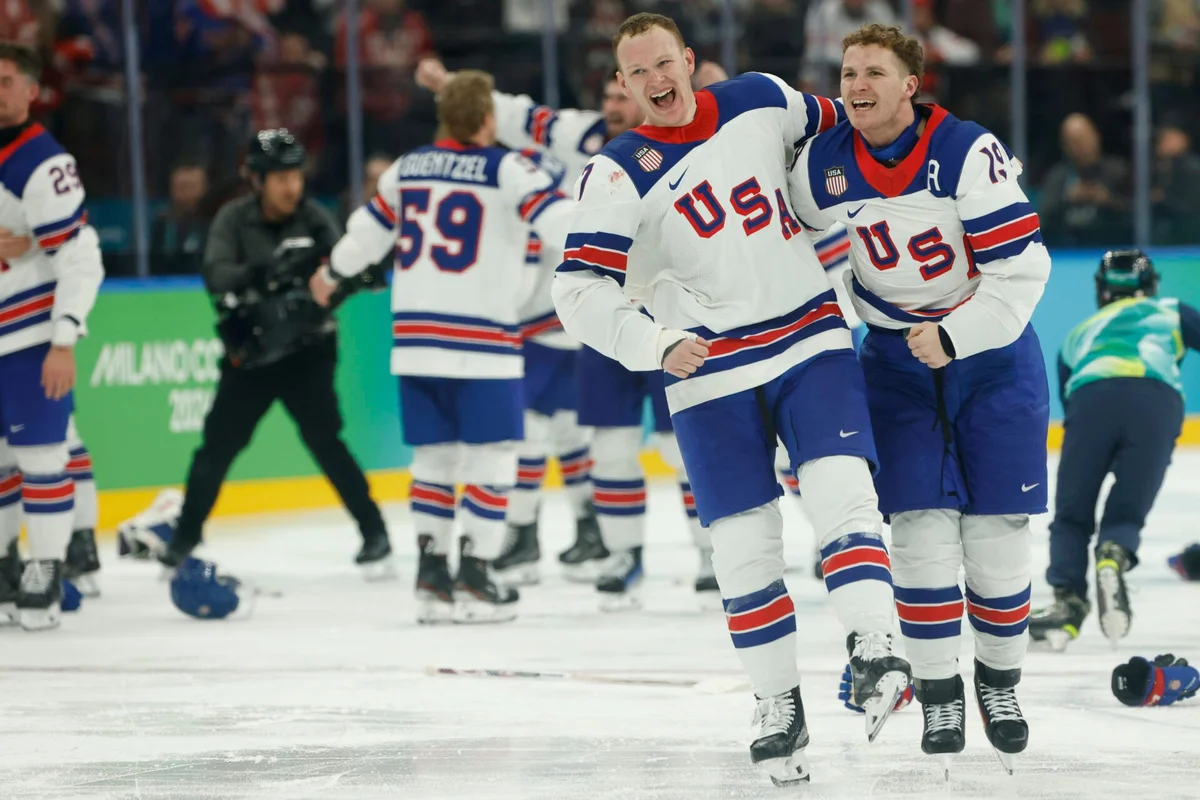
The U.S. men’s hockey roster featured two notable pairs of brothers who played key roles during the Winter Olympics. Quinn and Jack Hughes emerged as pivotal players, combining for 15 points in total. Jack scored four goals alongside three assists, while Quinn registered one goal and seven assists, including critical overtime goals that propelled Team USA to the gold medal game and ultimately secured the championship.
Meanwhile, siblings Matthew and Brady Tkachuk, who entered the tournament as anticipated dynamic contributors, combined for 11 points in total. Matthew recorded six assists, and Brady added three goals and two assists. Matthew had already experienced multiple White House visits with the Florida Panthers, fresh off consecutive Stanley Cup wins, while Brady attended the event for the first time following the Olympic triumph.
Details of the Fake AI Video and Its Reception
The White House posted a video on its official social media accounts after Team USA’s victory, which featured artificially generated audio making it sound as though Brady Tkachuk insulted Canada. The fabricated clip stated,
“They booed our national anthem so I had to come out and teach those maple syrup-eating f— a lesson. Canada, we own you lil bro.”
The post was accompanied by text emphasizing the gold medal victory over silver.
Despite being labeled with “Contains AI-generated media” on TikTok and featuring a noticeably unnatural delivery, some viewers took the clip at face value. Tkachuk strongly rejected the video’s authenticity on Thursday, clarifying his position.
“Well, it’s clearly fake, because it’s not my voice, not my lips moving. I’m not in control of any of those accounts. I know that those words would never come out of my mouth. So, I can’t do anything about it. It’s not my voice. It’s not what I was saying. I would never say that. That’s not who I am, so I guess I don’t like that video because that would never come out of my mouth and never had that thought,”
Tkachuk explained.
Team USA’s Complex Dynamics Amid White House Visit
The rivalry between the United States and Canada in hockey has deep roots and has been further complicated by political tensions, particularly under former President Donald Trump’s administration. The White House’s adoption of a “Terminally Online” strategy often blurs the lines between humor and diplomacy, as seen in viral meme-style posts like this AI-generated video.
Brady Tkachuk’s presence in the Oval Office marked a milestone for him personally, though the experience came with challenges. The team also encountered an awkward moment when President Trump joked about the U.S. women’s hockey team, prompting Tkachuk and his teammates to respond publicly.
I don’t really have an answer. It’s a whirlwind of a moment. You can’t control what somebody says. I guess I got caught off guard a little bit,
We support them, they support us.
– Brady Tkachuk, NHL player
Significance and Potential Fallout from the Incident
This episode underscores ongoing concerns about the misuse of AI technology in political and public domains, especially when employed to manipulate athletes’ images without consent. Tkachuk’s clear rejection of the fabricated video highlights the potential reputational risks that arise when state actors engage in disingenuous digital tactics.
While the video remains publicly accessible on the White House’s social media accounts, the backlash may prompt discussions about responsible digital content creation and the ethical limits of using artificial intelligence for political messaging. Both the hockey community and broader public audiences are likely to watch closely how such incidents are managed moving forward, particularly as relations between the U.S. and Canada continue to navigate sensitive territory.
