
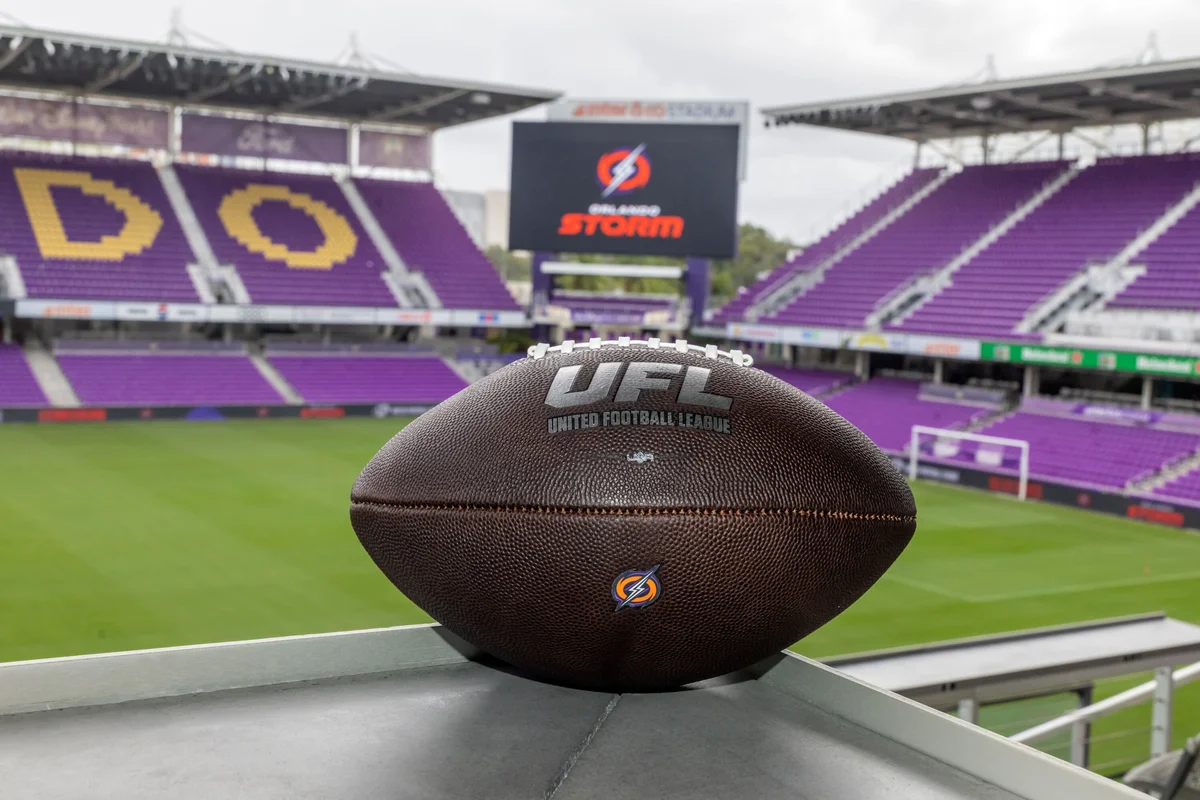
ARLINGTON, Texas — In an effort to increase excitement and innovation in professional football, the United Football League (UFL) announced new rules that restrict punting past the 50-yard line, with exceptions only during the last two minutes of each half. Additionally, the league will award four points for all field goals of 60 yards or longer, emphasizing the value of long-distance kicking in its upcoming season starting March 27.
This latest development by the UFL also includes the elimination of the “tush push,” effectively prohibiting players from pushing the quarterback forward immediately after the snap. The changes follow recent adaptations in kickoff rules inspired by the NFL, which have brought renewed attention to the spring league’s role as a testing ground for innovative football regulations.
Adjustments to Kickoff Procedures Create More Space for Returners
The UFL has revised its kickoff formation to promote dynamic returns. Kickoff team members will now lineup at the opponent’s 45-yard line instead of the usual 40, while the receiving team’s blockers will move five yards forward toward their own end zone. Both coverage players and blockers are required to remain still until the ball is either caught or lands in a clearly defined zone, giving the returners extra room to maneuver.

These changes aim to balance competitive action and safety, while encouraging more thrilling plays during kickoffs, one of the game’s most pivotal moments.
Restrictions on Punts Encourage Offensive Risks Beyond Midfield
The rule banning punts past the 50-yard line intends to discourage conservative playcalling and instead push teams to attempt conversions on fourth down, even if it means risking losing yardage. This limitation will not apply during the final two minutes of each half, providing some tactical flexibility in crucial moments.
If the ball is on the 50-yard line but has not yet crossed into opponent territory, teams will still be permitted to punt.
League Officials Stress Intention to Boost Scoring and Fan Engagement
Dean Blandino, UFL head of officials and a key figure in football rule development, highlighted the league’s broader goals in these changes.
“It is a tremendous source of pride,”
Blandino said of the UFL’s influence on NFL regulations.
“And I think it speaks to the need to have spring football. We’re not competing with the NFL, but we’re working in conjunction with the NFL. We’re preparing players, coaches, officials, to take that next step and to also try things and innovate, that the NFL can use.”
Reflecting on the punting ban, Blandino acknowledged the rule’s initial shock but noted it aligns with evolving trends in professional football.
“At first glance, it feels like a major, major change,”
Blandino shared.
“That’s how I looked at it when we started talking about it. Then you dive into the numbers a little bit and look at the NFL last year, fewest punts per game in modern history, most fourth-down attempts per game in modern history. So the game is trending that way anyway.”
He emphasized the focus on promoting plays that foster scoring and keep fans engaged rather than have stalled segments ending in routine fair catches.
“We just felt, what are we trying to promote?”
Blandino explained.
“We’re trying to provide exciting plays. We’re trying to promote scoring and fan excitement, engagement, those types of things. So we don’t want to see a ton of punts where it’s just a fair catch at the 10-yard line. It’s a non-action play.”
Higher Rewards for Long-Range Field Goals Encourage Dynamic Kicking
The move to award four points for field goals of at least 60 yards complements the punting restrictions by incentivizing teams to take more long-distance kick attempts. The UFL highlights recent examples of successful long field goals, such as Brandon Aubrey of the Dallas Cowboys, who developed in a spring football environment, as well as Jacksonville’s Cam Little, who not only set an NFL record with a 68-yard field goal in November but also kicked a 70-yarder during preseason.
Blandino noted that principal investor Mike Repole strongly supported rewarding kickers for these difficult attempts.
“We just felt like, ‘OK, let’s add a layer to this,’”
Blandino said.
“Kicking a 65-yard field goal is a lot harder than a 35-yard field goal. Why should they be the same?”
Removing the Tush Push Aims to Enhance Safety and Officiating
The UFL’s ban on the push by players behind the quarterback, commonly known as the tush push, addresses concerns for player safety and simplifies referees’ responsibilities. While the NFL narrowly voted against removing this tactic last year, the UFL is providing a platform to enforce the ban and evaluate its effects in game situations.
“Some of our teams used it and we just felt with everything, whether it’s safety, whether it’s the difficulty in terms of officiating it,”
Blandino said.
“We’re going to give them the opportunity to see how you can officiate it, how you kind of get it out. And we just feel like that’s not a play that we want in our game.”
Adopting College Rules and New Scoring Options for Conversions
The UFL is implementing the college rule requiring only one foot inbounds for a completed reception, differing from the NFL’s two-foot requirement. This change is expected to influence how passing plays are executed and officiated in the league.
For post-touchdown scoring, the UFL has introduced tiered point values: a 33-yard kick will be worth one point, a two-point conversion can be attempted from the 2-yard line, and a three-point conversion option is available from the 8-yard line. During overtime, teams will alternate three conversion attempts from the 5-yard line until one team gains an advantage.
Implications for the Future of Football and Player Development
The UFL’s innovative football rules underscore the league’s unique role as a testing ground for new ideas, aiming to increase excitement, promote scoring, and provide opportunities for players, coaches, and officials to refine their skills in a competitive setting. By challenging traditional norms — such as banning punts beyond midfield and rewarding longer field goals — the UFL may influence future adaptations in football at higher levels.
As the eight-team league prepares for its opening game on March 27, fans and experts alike will watch closely to see how these rule changes impact gameplay, strategy, and overall fan engagement throughout the season.
