San Antonio Spurs Overview
The San Antonio Spurs are an American professional basketball team based in San Antonio, Texas. Founded in 1967, the Spurs compete in the National Basketball Association (NBA) as a member of the Southwest Division of the Western Conference. The team plays its home games at Frost Bank Center and is one of four former American Basketball Association (ABA) franchises to remain intact in the NBA after the 1976 ABA–NBA merger.
The franchise has won five NBA championships, in 1999, 2003, 2005, 2007, and 2014, and is the only former ABA team to have won multiple NBA titles. As of the 2022–23 season, the Spurs held the highest winning percentage among active NBA franchises. From 1999–2000 to 2016–17, the Spurs won at least 50 games each season, setting an NBA record of 18 consecutive 50-win seasons. The team’s identity is tied to its silver, black, and white colors, the mascot The Coyote, and a long-running reputation for consistency and excellence.
Founding and Organizational Origins
The San Antonio Spurs began as the Dallas Chaparrals of the original American Basketball Association in 1967. Coached by player-coach Cliff Hagan, the Chaparrals were one of 11 teams to play in the ABA’s inaugural season. Despite on-court results, the franchise struggled financially in Dallas, in part because ownership refused to invest heavily in the team. During the 1970–71 season, the club was briefly rebranded as the Texas Chaparrals in an attempt to operate as a regional team, but that experiment failed.
By the 1972–73 season, the franchise was sinking financially and the ownership group wanted to sell. A group of 35 San Antonio businessmen, led by Angelo Drossos, John Schaefer, and Red McCombs, negotiated a lend-lease deal with the Dallas owners, agreeing to lease the team for three years with an option to purchase. Before ever playing a game as the planned San Antonio Gunslingers, the franchise was renamed the Spurs. The team adopted silver, black, and white colors and introduced a smothering defense as its on-court trademark.
Growth Into NBA Competition
The Spurs played their inaugural San Antonio season in 1973–74 at HemisFair Arena, drawing large crowds and embracing an up-tempo style. They acquired George Gervin from the Virginia Squires, and his arrival marked the start of the team’s rise within the ABA. The franchise qualified for the postseason each year it remained in the ABA and reached the playoffs regularly.
When the ABA–NBA merger took effect in 1976, the Spurs joined the NBA along with the Denver Nuggets, the Indiana Pacers, and the New York Nets. The incoming ABA teams faced draft and television-revenue restrictions but adjusted steadily. The Spurs won five division titles in their first seven NBA seasons and became a perennial playoff presence. With David Robinson drafted in 1987 and arriving in 1989, and Tim Duncan selected first overall in 1997, the Spurs built the foundation for sustained championship-level performance.
San Antonio Spurs Competitive Journey
The Spurs’ competitive journey traces a steady climb from ABA newcomer to NBA dynasty. After early playoff disappointments, the franchise matured into one of the league’s most stable winners under Gregg Popovich, capturing championships in 1999, 2003, 2005, 2007, and 2014. Following Duncan’s retirement in 2016, the team navigated a transitional era before re-emerging as a conference finalist in 2026 behind Victor Wembanyama.
Early Seasons and Development (1967–1985)
The early Spurs were defined by George Gervin’s scoring brilliance. In 1977–78, Gervin scored 63 points in the final game of the season to overtake David Thompson for the NBA scoring title. The Spurs captured five division titles in their first seven NBA seasons but repeatedly fell short in the playoffs, including a 1979 conference finals loss to the Washington Bullets after leading 3–1.
Through the early 1980s, the Spurs posted winning records but were eliminated in early playoff rounds by teams such as the Houston Rockets and the Los Angeles Lakers. After the 1984–85 season, Gervin was traded to the Chicago Bulls, effectively closing the franchise’s first era. The following four seasons were difficult, with the Spurs going 115–213 and contending with declining attendance and relocation rumors.
Breakthrough in the NBA (1987–1998)
The Spurs used the 1987 NBA draft lottery to select David Robinson from the United States Naval Academy. Robinson’s 1989 arrival, combined with the 1989–90 debut of head coach Larry Brown, produced the largest one-season turnaround in NBA history, as the Spurs jumped from 21–61 to 56–26. Robinson won Rookie of the Year, and the team reached the playoffs consistently through the early 1990s.
Peter M. Holt and a group of 22 investors purchased the Spurs in 1993 for $75 million, anchoring long-term local ownership. Following a difficult 1996–97 season in which injuries decimated the roster, the Spurs won the draft lottery and selected Tim Duncan first overall. The combination of Robinson and Duncan, known as the Twin Towers, signaled a new championship era.
Modern Program and Current Direction (1997–Present)
With Duncan and Popovich leading the program, the Spurs became a model of sustained success. The franchise won championships in 1999, 2003, 2005, 2007, and 2014, and reached the NBA Finals again in 2013 and 2014. Stars such as Tony Parker, Manu Ginóbili, and Kawhi Leonard joined the core, while Becky Hammon became the first full-time female coach in a major U.S. professional sports league when she was hired as an assistant in 2014.
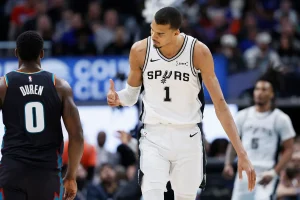
After Duncan’s retirement in 2016, the Spurs remained competitive but eventually missed the playoffs in 2020, ending an NBA-record 22 consecutive postseason appearances. In 2023, the franchise selected Victor Wembanyama with the first overall pick. Wembanyama won Rookie of the Year and, paired with De’Aaron Fox, helped the Spurs return to the playoffs in 2026 and reach the NBA Finals for the first time since 2014.
Philosophy and Competitive Strengths
The Spurs have long emphasized unselfish ball movement, defensive accountability, and a deep rotation built on player development. Under Popovich, the franchise favored versatile lineups and trusted role players to fill specialized roles. Recent iterations have layered that foundation with modern pace-and-space principles and the switchable defense enabled by Wembanyama’s length.
Key Milestones and Major Moments
The franchise’s defining milestones include its 1999 NBA championship as the first former ABA team to win the title, the 2014 Finals MVP run by Kawhi Leonard, and the 2026 Western Conference Finals victory over the Oklahoma City Thunder. The Spurs also matched an NBA record with 22 consecutive playoff appearances (1998–2019) and set an NBA record with 18 straight 50-win seasons from 1999–2000 to 2016–17.
San Antonio Spurs Achievements and Results
The Spurs have won five NBA championships, six conference titles, and more than 20 division titles since joining the NBA. The franchise has built one of the league’s most consistent track records, punctuated by long playoff streaks and multiple Hall of Fame careers.
NBA Achievements
The Spurs captured NBA championships in 1999, 2003, 2005, 2007, and 2014. The 1999 title came in a lockout-shortened season and was the franchise’s first. The 2014 championship featured a dominant five-game victory over the Miami Heat and Kawhi Leonard’s emergence as a Finals MVP. The Spurs have also reached the NBA Finals in 2013 and 2026.
Conference Achievements
The Spurs have won six Western Conference championships, in 1999, 2003, 2005, 2007, 2013, and 2014. The franchise reached the Western Conference finals multiple additional times, including a 2026 appearance that ended with a seven-game victory over the Oklahoma City Thunder. These runs helped establish the Spurs as a model of conference-level consistency.
Divisional Achievements
The Spurs have captured 22 Southwest Division titles, including multiple streaks through the late 1990s and 2000s. The franchise’s divisional dominance was a foundation for its deep playoff runs, with regular-season excellence frequently translating into home-court advantage. The Spurs also won the Southwest Division again in 2026, marking their first divisional crown since 2016–17.
Series Achievements
Across the NBA regular season and playoffs, the Spurs have recorded extended winning streaks, including an NBA-record 18 consecutive 50-win seasons from 1999–2000 to 2016–17. The franchise has also developed numerous All-Stars and individual award winners, reflecting a sustained ability to compete at the highest levels of the league.