
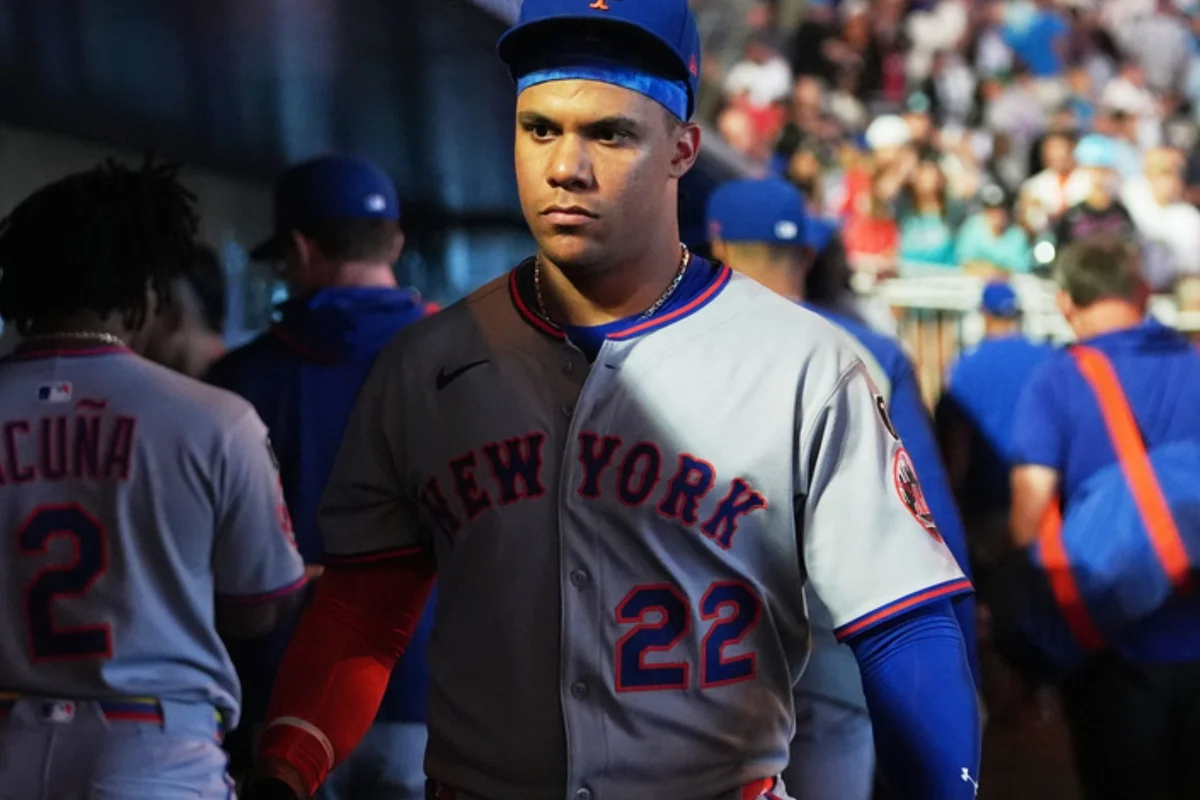
As pitchers and catchers gather for spring training this week, Major League Baseball confronts escalating tensions over its 2026 season’s financial framework. With the current collective bargaining agreement (CBA) expiring December 1, 2026, discussions between team owners and the MLB Players Association remain deeply divided, centered largely on the contentious issue of instituting baseball’s very first salary cap. This critical dispute arises as owners push for the salary cap, while players, represented by the union, categorically oppose it, fearing constraints on player earnings.
The negotiations have reached an impasse amid rising concerns of a lockout. Commissioner Rob Manfred has acknowledged the significant leverage a lockout carries, likening it to
“a .22 (caliber firearm), as opposed to a shotgun or a nuclear weapon,”
underlining its potential, though measured, impact. Meanwhile, players anticipate a work stoppage soon after the season ends, with MLBPA Executive Director Tony Clark warning,
“Unless I am mistaken, the league has come out and said there’s going to be a work stoppage.”
Historical Labor Conflicts Cast Long Shadows on Current Dispute
The current conflict stirs memories of MLB’s darkest labor episode — the 1994-95 strike that led to the unprecedented cancellation of the World Series for the first time in over 90 years. That strike began on August 12, 1994, triggered by owners’ insistence on a salary cap, and dragged on for 232 days, resulting in nearly 950 games canceled.
The financial damage then was enormous: the league suffered an estimated $580 million loss, while players forfeited $230 million in salaries. The fallout extended far beyond economics, bruising fan loyalty as game attendance fell by 20% the following year, tumbling from an average of 31,256 per game in 1994 to just 25,008 in 1995.
The strike’s cultural impact lingered, with television ratings dropping sharply, eclipsing declines after the 1981 strike. The cancellation robbed baseball of landmark achievements such as Matt Williams’ chase for Roger Maris’ home run record and Tony Gwynn’s bid for a .400 batting average, fueling lasting bitterness among fans. The Montreal Expos, holders of the league’s best record when play halted, ultimately never recovered and relocated to Washington, D.C., a move that still echoes in baseball’s history.
How the Luxury Tax Shapes MLB’s Current Spending Environment
Rather than a hard salary cap, MLB currently relies on a luxury tax system known as the competitive balance tax, established in 1997 and refined over successive CBAs. This soft cap penalizes teams for exceeding a set payroll threshold, which for 2026 stands at $244 million.
Teams crossing this limit face escalating fines: a 20% tax on overages in the first violation year, climbing to 30% for a second consecutive year, and 50% for subsequent years. Additional surcharges activate at $264 million (12% extra), $284 million (up to 45% extra), and $304 million (60% extra), the last known as the “Cohen Tax” after Mets owner Steve Cohen.
Despite these penalties, many of baseball’s richest clubs continue to spend at unprecedented levels. In 2025, nine teams surpassed the luxury tax threshold — a new high. Critics contend this tax acts more as a calculable expense for wealthier teams than a genuine deterrent to runaway payrolls.
Los Angeles Dodgers’ Record-Breaking Payroll and Tax Bill Highlight Spending Gap
The Los Angeles Dodgers exemplify the current system’s inefficiencies. As back-to-back World Series champions, their 2025 luxury tax bill reached $169.4 million, based on a colossal $417.3 million payroll, marking the highest payroll in MLB history. Taking into account tax payments, their overall 2025 spending soared to $586.7 million — surpassing total payrolls of a dozen MLB clubs combined.
Looking ahead to 2026, the Dodgers remain at the top, bolstered by the recent signing of Kyle Tucker to a four-year, $240 million deal, pushing their projected payroll to $413.6 million, which is $96 million more than any other team. Other high spenders include the New York Mets with an estimated $312.5 million payroll and the New York Yankees.
This stark discrepancy has fueled demands for reform. The Dodgers’ 2025 payroll alone exceeded the combined salaries of the league’s six lowest-spending teams. By contrast, the Miami Marlins operate with a payroll around $79 to $80 million, exposing the vast gulf within MLB’s financial landscape.
Small-market franchises argue the current model is unsustainable. Colorado Rockies owner Dick Monfort insists,
“the only way to fix baseball is to do a salary cap and a floor.”
Even Yankees owner Hal Steinbrenner, representing a traditionally high-spending club, admits,
“It’s difficult for most of us owners to be able to do the kinds of things (the Dodgers) are doing,”
reflecting broader owner frustration at payroll imbalances.
The Latest Collective Bargaining Agreement and Its Limitations
The 2022-26 CBA, spanning 426 pages and finalized after a lengthy 99-day lockout, outlines key financial and operational terms for MLB teams and players. It raises minimum salaries, provides performance bonuses for promising young players, and enforces revenue sharing whereby 31% of local net revenues contribute to a pool distributed evenly across all 30 teams.
The agreement also created a Competition Committee with 11 voting members, including four players, six MLB representatives, and one umpire, to propose rule changes. It formalizes international game protocols and modestly expanded the playoff structure.
Notably absent from this extensive document is any mention of a salary cap or floor. Previous negotiations saw ownership advocate aggressively for such limits, but players successfully resisted, branding a salary cap as “institutionalized collusion,” in the words of Tony Clark.
Insights from Experts and Negotiation Dynamics
Industry experts foresee a difficult bargaining cycle ahead. ESPN analyst Jeff Passan anticipates an increasing likelihood that the league will lock out players on December 1, 2026, as negotiations intensify during spring training and throughout late fall that year. Evan Drellich of The Athletic reports a strong push from ownership for a salary cap, though notes,
“many player agents and club executives [are] skeptical games will be lost.”
Leading the talks for MLB are Deputy Commissioner Dan Halem and Commissioner Rob Manfred, while Deputy Executive Director Bruce Meyer and Tony Clark spearhead the players’ side. The latter includes an eight-member subcommittee featuring prominent players like Cy Young winners Paul Skenes and Tarik Skubal.
Some observers suggest a salary floor — compelling lower-spending teams to raise payrolls — could serve as a middle ground paired with a cap holding back wealthier clubs. However, the players’ union views any combination resembling a cap as unacceptable, fearing constraints on player income.
Adding complexity are expiring national television contracts in 2028. Owners hope to consolidate team local TV rights into lucrative streaming deals, but a lost 2027 season caused by a work stoppage could jeopardize those negotiations, potentially costing more than the owners might gain from a favorable CBA.
Player sentiment is bleak, reflecting anxiety and forewarning. Baltimore Orioles first baseman Pete Alonso, who signed a five-year, $155 million deal in late 2024, remarked last July,
“No one’s talking about it, but we all know that they’re going to lock us out for it, and then we’re going to miss time.”
How MLB’s Salary System Compares to Other Major Sports
Among major North American professional leagues, MLB is unique in lacking a hard salary cap. By contrast, the NFL and NHL both enforce hard caps, while the NBA employs a soft cap with stricter luxury tax penalties than those seen in baseball.
For 2024-25, the NFL’s salary cap stands near $255 million per team, paired with a floor requiring teams to spend at least 89% of that cap over four years. The NHL’s corresponding cap is $88 million, with a $65 million floor. Both leagues tie these caps to fixed percentages of league revenue, thus guaranteeing players a designated revenue share.
The NHL’s path to a hard cap offers cautionary insights. Owners locked out players for the entire 2004-05 season, canceling the full campaign — the only such cancellation in North American professional sports history — before players acquiesced to a cap. Earlier attempts to impose caps during the 1994-95 NHL strike achieved only a shortened season, with a full lockout necessary to enforce change.
Proponents of salary caps argue that they promote competitive balance by encouraging lower-spending teams to increase payroll. Studies indicate that caps can boost average player salaries, as “have-not” teams invest more, believing in their competitive chances. For example, average NHL team payrolls rose 138% from 2005-06 through 2019-20 following cap adoption.
Critics, however, point out MLB has managed competitive balance without an official salary cap. Data shows baseball rivals other leagues in postseason diversity despite having fewer playoff teams, suggesting the luxury tax system has not hampered competition significantly.
Labor Peace at Risk as MLB Approaches Critical Season
MLB enjoyed its longest labor peace stretch from 1995 to 2021 but faced a renewed lockout in 2021-22 that delayed Opening Day. That episode exposed both sides’ readiness to leverage work stoppages amid disputes.
To prepare for potential lost wages, the players’ union has amassed a reserve fund from licensing revenues derived from cards, video games, and merchandise sales. In December 2024, the executive board voted to withhold 100% of licensing income in anticipation of challenging negotiations.
For a generation of fans who lived through the 1994 strike, the current atmosphere echoes those fraught times. Back then, labor strife canceled Montreal’s greatest title hopes, halted historic record pursuits, and alienated countless supporters. As pitchers and catchers begin another season under a CBA that will expire soon, the question remains whether MLB can avert a repeat of that painful chapter.
