

The Miami Marlins entered the 2026 offseason continuing their approach of cautious spending combined with strategic trades focused on acquiring controllable young talent. The team prioritized cost control and developmental upside while making limited investments in free agency, reflecting an ongoing commitment to build a sustainable core without large financial commitments.
This approach aligns with the Marlins offseason moves, as their pursuit of stability has led to trading established pitchers for promising prospects and signing low-cost veterans to fill roster needs rather than pursuing high-profile free agents.
Free Agent Signings and Financial Commitments
In free agency, the Marlins made a series of modest, one-year deals totaling around $20.5 million, targeting specific pitching and positional roles without overextending the payroll. Key additions included right-hander Pete Fairbanks, signed to a one-year, $13 million contract to serve as a late-inning closer, right-hander Chris Paddack on a one-year, $4 million deal to bolster the rotation, and versatile Christopher Morel on a one-year, $2 million contract, projected to handle first base despite limited experience there.
Left-hander John King was also added for $1.5 million on a one-year contract to strengthen the bullpen. These acquisitions reflect the Marlins’ preference for “buy-low” players with upside rather than established veterans commanding multi-year, high-value contracts.
Major Trades and Prospect Acquisitions
The Marlins actively moved several young major-league pitchers, focusing on replenishing their farm system and repositioning talent to fit their tactical vision. They traded right-hander Edward Cabrera to the Chicago Cubs, receiving outfielder Owen Caissie and infield prospects Cristian Hernández and Edgardo De Leon in return. Caissie is considered the centerpiece of this deal, a left-handed power hitter with six years of team control and potential to strengthen Miami’s outfield.
Left-handed pitcher Ryan Weathers was dealt to the New York Yankees for a package of four minor-league players, including outfielders Dillon Lewis and Brendan Jones as well as infielders Dylan Jasso and Juan Matheus. Weathers, with three years of club control remaining, was a surprising outside candidate to be moved but the trade emphasizes the Marlins’ commitment to stockpiling prospects rather than retaining expensive, injury-prone pitchers.
Other trades focused on role players, moving outfielders Dane Myers to the Cincinnati Reds for minor-league outfielder Ethan O’Donnell, and Victor Mesa Jr. to the Tampa Bay Rays for minor-league infielder Angel Brachi. Utility player Eric Wagaman was sent to the Minnesota Twins in exchange for right-handed minor league pitcher Kade Bragg, expected to contribute in the near future.
The team also dealt left-handed reliever Josh Simpson and outfielder Joey Wiemer to the Seattle Mariners and San Francisco Giants respectively, both for cash considerations, while acquiring outfielder Esteury Ruiz from the Los Angeles Dodgers and right-handed pitcher Bradley Blalock from the Colorado Rockies to add depth.
Miami further enhanced its bullpen by claiming right-handed pitchers Garrett Acton off waivers from the Rockies, Osvaldo Bido from the Rays (later lost to the Angels), and Zach Brzykcy from the Nationals (later outrighted to Triple-A).
Minor League Signings and Contract Discussions
The Marlins added depth through minor league deals with several players including Jesus Tinoco, Daniel Johnson, Tyler Zuber, and Brian Navarreto. Despite no extensions finalized, the team has held talks with outfielders Kyle Stowers and Jakob Marsee about potential long-term agreements, reflecting interest in retaining young talent but hesitancy to commit firmly given budget constraints.
Departures and Notable Roster Changes
The offseason saw the departure of several contributors from the prior roster. Besides Cabrera and Weathers, outfielders Myers, Mesa Jr., and Wiemer, along with utility player Wagaman, left via trades. Additional exits included Troy Johnston (picked up by Colorado Rockies), George Soriano (claimed by Baltimore Orioles), and left-handed reliever Josh Simpson, who was traded for cash after struggling in 2025.
The loss of these players signified a willingness to part with veteran and fringe major-league contributors, emphasizing Miami’s preference for youth and cost-controlled talent.
Performance Context and Organizational Outlook
Miami ended the 2025 campaign with an overall 79-83 record, finishing third in the National League East after a stronger 56-50 showing through the final four months. Despite a poor start, this finish was viewed as encouraging, given limited offseason activity the previous year and the team’s historical role as sellers rather than buyers.
Peter Bendix, entering his third offseason as president of baseball operations, and manager Clayton McCullough, in his second season, maintained a focus on gradually improving the roster through shrewd acquisitions and internal player development rather than aggressive big-money moves.
Filling Team Needs with Economical Solutions
The offseason priorities included reinforcing first base, the bullpen, and the outfield, all addressed with low-cost moves rather than marquee signings. Christopher Morel’s addition as a makeshift first baseman is a calculated risk, given his raw power balanced against limited defensive versatility and high strikeout rates. His contract includes three years of club control, offering potential upside if he can develop into a reliable middle-of-the-order bat.
Recognizing the need for a reliable closer, the Marlins signed Pete Fairbanks, turning down his former team’s $11 million option to ink a $13 million deal. Fairbanks represents the highest one-year salary ever given to a Marlins reliever, bringing experience and velocity to a bullpen that lacked a defined closer in 2025.
Chris Paddack and John King strengthen pitching depth, though both arrive with question marks. Paddack, a former top prospect, has struggled recently with a high ERA but offers outstanding command. King is brought in for his ground-ball inducing ability, despite a down year in 2025.
Trading Young Pitchers for Future Depth
A central theme of the Marlins offseason was dealing from their stock of young, durable pitching assets. Unlike many who expected ace Sandy Alcantara to be on the trade block given his injury history and contract size, it was Edward Cabrera and Ryan Weathers who were moved. While Cabrera came with durability concerns, his impressive 2025 breakout season made him attractive to other clubs, prompting a trade to the Cubs that brought promising outfielder Owen Caissie and two infield prospects.
Weathers’ trade to the Yankees was less anticipated, particularly as he had three years of club control remaining, but the haul of four minor league prospects deepens the Marlins’ position player ranks and fits their developmental focus.
Prospects and Future Core Pieces
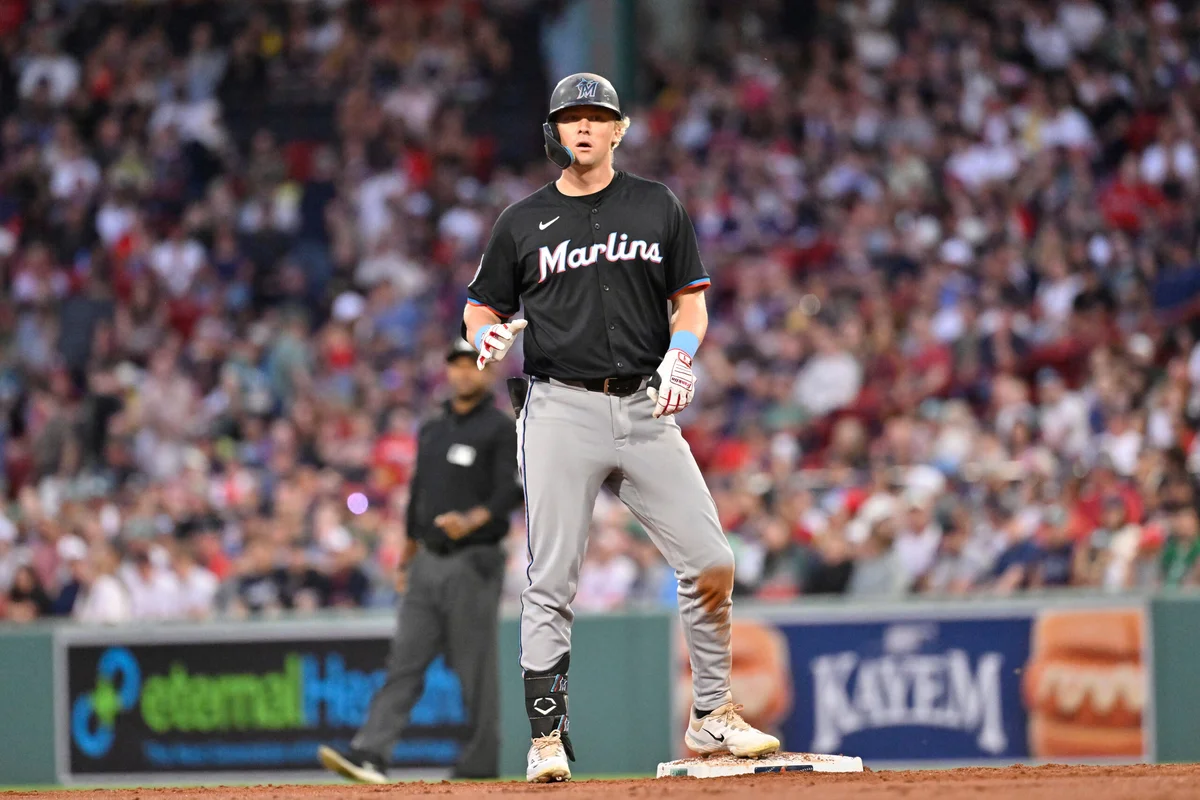
Owen Caissie stands out among the incoming talent as a potential cornerstone, bringing left-handed power and a strong arm to Miami’s outfield. Alongside Kyle Stowers, acquired earlier, and rookie Jakob Marsee, who posted promising offensive numbers in his debut, the Marlins believe they have the foundation for a young outfield with middle-of-the-order potential.
Infield depth will be tested with rookies Graham Pauley and Connor Norby likely to compete for corner infield roles, while the middle infield features standout defenders Otto Lopez at shortstop and Xavier Edwards at second base. Catching duties appear headed towards former top prospect Agustin Ramirez, with prospect Joe Mack waiting in Triple-A and potentially transitioning to first base or designated hitter roles.
Pitching Staff Composition and Expectations for 2026
The pitching staff will be led by Sandy Alcantara alongside Eury Pérez and returning veterans like Chris Paddack. Top pitching prospects Thomas White and Robby Snelling are positioned for possible Major League debuts, while Max Meyer and Braxton Garrett return from injuries, adding depth to the rotation. Additional arms including Dax Fulton and Adam Mazur provide further organizational flexibility.
The bullpen, despite losing Ronny Henriquez to Tommy John surgery, features Fairbanks as closer, John King as a dependable lefty, and holdovers such as Southpaw Cade Gibson, Calvin Faucher, and Anthony Bender. This group is seen as solid but not spectacular, reflecting the ongoing challenge for Miami to build a high-impact relief corps within budget limitations.
Payroll Constraints and Long-Term Financial Strategy
The Marlins’ projected payroll for 2026 sits near $73 million, placing them among the lowest-spending teams in Major League Baseball. This financial conservatism hampers their ability to add impact free agents or extend young stars for long-term deals. With only the five-year, $56 million contract of Alcantara representing a significant long-term extension in recent years, questions persist over whether Miami will invest substantially to retain emerging talents like Marsee or Stowers.
The current budget restrictions paired with reported revenue-sharing funds of approximately $70 million have stirred concerns about the allocation of resources and the potential limitations on growth. Yet, the Marlins have begun preliminary extension talks with their young outfielders, which may offer some stability if deals are finalized.
Overall Impact and Fan Response to the Offseason
Despite multiple smart moves aimed at building a cost-efficient, youthful roster, many observers and fans have responded to the Marlins’ offseason with ambivalence and skepticism. A recent poll of MLBTR readers graded the Marlins’ efforts mostly in the C range (37%), followed by B (28%) and D (21%), indicating a perception of modest progress tempered by unresolved questions.
The 2026 season will be pivotal for the Marlins to determine if their blend of prospect acquisitions, veteran depth signings, and cautious payroll management can generate sustained competitiveness in a demanding National League East division.
