
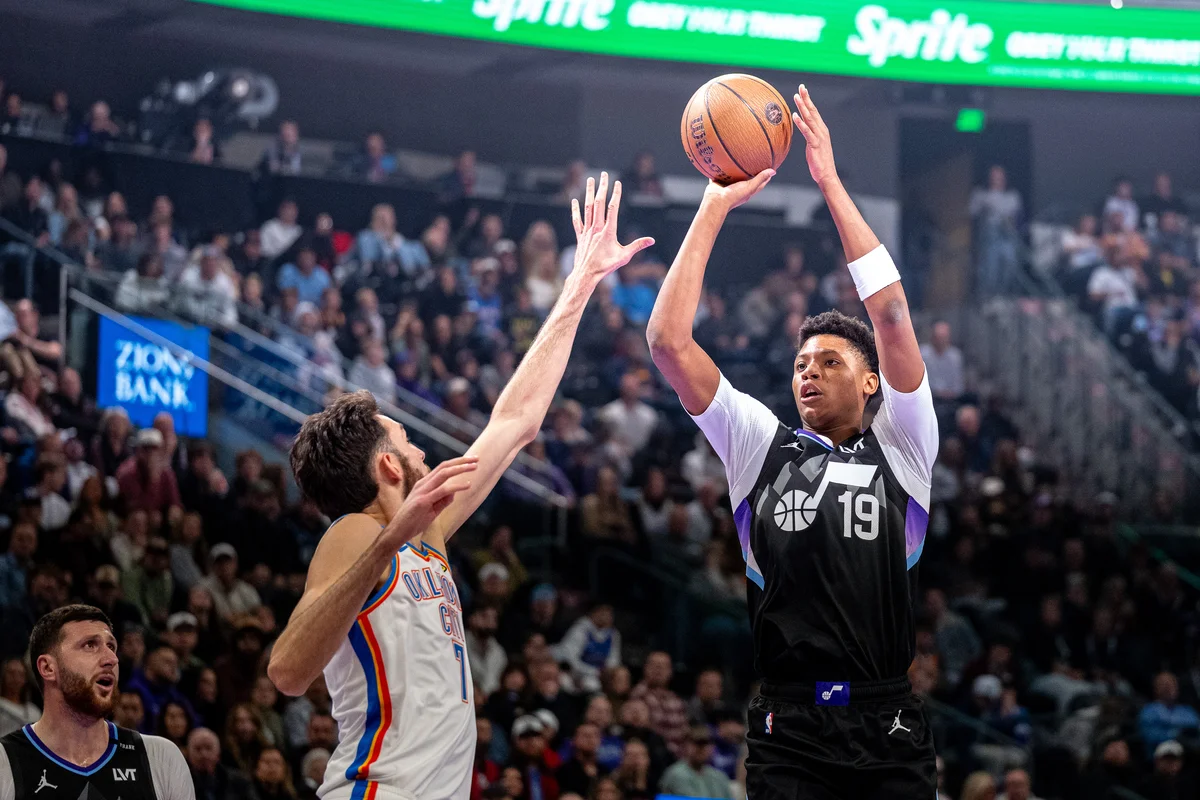
Ace Bailey, regarded as one of the most promising recent selections by the Utah Jazz, has yet to fully demonstrate his potential during his rookie season. Although his performance has not dazzled statistically, his talent is evident. Former NBA player and NCAA champion Rashad McCants has expressed concern that the Jazz are not providing Bailey enough chances to prove his capabilities on the court.
In a detailed conversation with The J-Notes, McCants pointed out that many of this year’s top NBA draft picks are being given ample opportunities to display their skills because their teams are not restricting their growth. He contrasted Bailey’s situation with other rookies who benefit from more freedom to develop.
They’re going through the one-and-done thing. Even a guy like Cooper Flagg, who last year, I believe, was mediocre, but he’s always been talented potential, and so he’s able to flourish now with the Mavericks, (they) give him the opportunity to play and gain confidence. All of these guys are under the same umbrella. They’re all playing mediocre, whether they’re putting up numbers or not, but they’re able to show that their talent and their potential can gain traction if they get the right opportunities,
McCants said.
Comparison Between Ace Bailey and Dylan Harper Reflects Team Circumstances
McCants also analyzed Bailey’s limited chances through the lens of the Utah Jazz’s current rebuilding phase, which affects the environment in which Bailey is attempting to develop. He compared Bailey to Dylan Harper, whose growth trajectory differs significantly because of the Spurs’ competitive standing.
You look at a guy like Ace Bailey in comparison to Dylan Harper. Ace is with the Utah Jazz, who are currently tanking. He doesn’t get to showcase his ability to the utmost because he’s not in the winning situation. Dylan Harper, on the other hand, he’s showing that he’s a very viable piece, and he has an upside that is very tremendous. And so you look at the dynamic of where you go, that’s all going to be based on how you perform.
This contrast illustrates how team strategy and context can impact a young player’s opportunities and development, with Bailey receiving a more cautious approach from the Jazz while Harper faces higher expectations amid a winning team.
Recent Jazz Game Reflects the Challenges for Ace Bailey
Last night’s game further showcased the situation Bailey faces. The Utah Jazz suffered a defeat to the Houston Rockets, a team vying for playoff positioning, while the Jazz continue their focus on securing favorable draft odds. Despite the absence of key players such as Keyonte George, Jaren Jackson Jr., and Jusuf Nurkic, Bailey had the fifth-highest field goal attempts among active Jazz players.
While offensive leaders Lauri Markkanen and Brice Sensabaugh understandably commanded more shot attempts, teammates Isaiah Collier and Kyle Filipowski surpassed Bailey’s shot count, raising questions about his role relative to other players. Kevin Love took nearly as many shots as Bailey despite his veteran status and limited court time.
Bailey’s shooting performance was underwhelming, as he made two of nine field goal attempts, yet the Jazz’s ongoing struggles this season focus attention on his potential for future contributions if given a larger offensive role.
Expectations for Ace Bailey and His Future Prospects with the Jazz
As Bailey continues to adjust to the NBA, comparisons to legendary shooter Ray Allen have emerged, although such parallels remain speculative at this stage. The core issue lies in whether the Jazz will provide Bailey the freedom to maximize his talents and grow into a major contributor.
With the team currently prioritizing rebuilding and draft positioning, how the Jazz decide to deploy Bailey moving forward will be crucial in determining his trajectory in the league and whether he can fulfill the promise that attracted attention when he was selected.
