Utah Jazz Overview
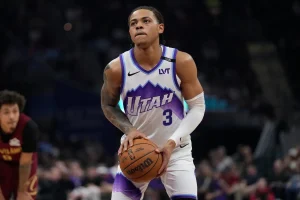
The Utah Jazz are a professional basketball team based in Salt Lake City, Utah. The Jazz compete in the National Basketball Association (NBA) as a member of the Northwest Division of the Western Conference. Since the 1991–92 season, the team has played its home games at the Delta Center, an arena they share with the Utah Mammoth of the National Hockey League (NHL). The franchise was founded on June 7, 1974, originally as the New Orleans Jazz, paying homage to New Orleans as the cultural home of jazz music, before relocating to Salt Lake City on June 8, 1979.
The franchise is owned by Ryan Smith, with Danny Ainge serving as Chief Executive Officer, Austin Ainge as President of Basketball Operations, and Justin Zanik as General Manager. Will Hardy serves as the team’s head coach. The team’s colors are mountain purple, midnight black, sky blue, and gray, and its mascot, Jazz Bear, has energized fans since 1994. The Jazz have made two NBA Finals appearances, in 1997 and 1998, both ending in losses to the Chicago Bulls, and have yet to win an NBA championship.
Founding and Organizational Origins
On June 7, 1974, the New Orleans Jazz were admitted as an expansion franchise into the NBA. The first owner of the team was an ownership group led by Sam Battistone. Team officials selected the name because of its dictionary definition: collective improvisation. The franchise’s original colors of purple, gold, and green were inspired by Mardi Gras in New Orleans. The team’s first major move was to trade for star player Pete Maravich, who had starred at Louisiana State University, from the Atlanta Hawks for two first-round draft picks, three second-round picks, and one third-round pick over the next three years.
Venue issues were a continual problem for the team in its early New Orleans years. In the Jazz’s first season, they played in the Municipal Auditorium and Loyola Field House, where the basketball court was raised so high that the NBA Players Association required the team to install a net around the court to prevent players from falling into the stands. Later, the Jazz played games in the cavernous Louisiana Superdome, but conditions were no better, due to high demand for the stadium, onerous lease terms, an 11 percent amusement tax, and Maravich’s recurring knee problems. The team also faced a possible month-long road trip each year because of Mardi Gras festivities.
Growth Into NBA Competition
Deciding the Jazz were no longer viable in New Orleans, Battistone moved the franchise to Salt Lake City, even though it was a smaller market. Salt Lake City had previously been home to the Utah Stars of the American Basketball Association (ABA) from 1970 to 1976, and the Stars had been extremely popular before financial troubles shut the team down in December 1975. The franchise kept the Jazz name because there was not enough time before the start of the 1979–80 season to receive league approval for a change. The NBA would return to New Orleans in 2002 when the Charlotte Hornets relocated to become the New Orleans Hornets.
In April 1985, auto dealer Larry H. Miller bought 50 percent of the team from Battistone for $8 million, stabilizing the franchise’s finances. Miller purchased Battistone’s remaining 50 percent for $14 million in 1986, preventing a sale that would have moved the team to Minneapolis. Under Miller’s ownership, the franchise grew into a model NBA organization. On October 28, 2020, the organization announced that Ryan Smith, co-founder of Qualtrics, had purchased the team from the Miller family, agreeing to keep the Jazz in Utah.
Utah Jazz Competitive Journey
The Jazz have built one of the most distinctive journeys in modern NBA history. After a difficult expansion period in New Orleans and early years in Utah, the team rose to prominence behind the John Stockton and Karl Malone partnership, reached two NBA Finals, endured a post-Stockton and Malone rebuild, returned to contention with Donovan Mitchell and Rudy Gobert, and entered a new era of change after trading both stars in 2022.
Early Seasons and Development (1974–1984)
Tom Nissalke departed as coach after the Jazz started the 1981–82 season 8–12, and general manager Frank Layden replaced him. By 1983, the team was losing money, and management experimented with stunts such as playing games at the Thomas & Mack Center in Las Vegas. On-court fortunes improved, however, with a healthy Adrian Dantley, Jeff Wilkins, and rookie Thurl Bailey at the forward positions, Mark Eaton and Rich Kelley jointly manning the post, Rickey Green and Darrell Griffith at the guards, and John Drew off the bench. The team went 45–37 and won the Midwest Division, marking the first winning season and division championship in franchise history.
The 1984 NBA draft produced the first cornerstone of the future. The 1984–85 season saw the emergence of Mark Eaton as a defensive force, averaging 5.6 blocks per game, an NBA single-season record, along with 9.7 points and 11.3 rebounds, and winning the NBA Defensive Player of the Year Award. The Jazz returned to the playoffs and upset the Houston Rockets 3–2 in the first round before losing to the Denver Nuggets 4–1 in the second round.
Breakthrough in the NBA (1984–2003)
The 1985 NBA draft added Louisiana Tech forward Karl Malone, who made an immediate impact in 1985–86 by averaging 14.9 points and 8.9 rebounds. For the 1987–88 season, John Stockton took over for Rickey Green as the starting point guard, and Malone established himself as one of the better power forwards in the league. The team finished 47–35 and pushed the Los Angeles Lakers to seven games in the Western Conference semifinals, hinting at title potential. In 1988–89, Frank Layden stepped down as head coach and was replaced by Jerry Sloan; the Jazz won 51 games and the Midwest Division.
In 1991–92, the most successful season in team history to that point, the Jazz moved to the Delta Center, finished 55–27, and reached the Western Conference Finals for the first time. The 1993–94 season brought Jeff Hornacek from Philadelphia, and Utah advanced again to the Western Conference Finals, where it lost to the eventual NBA champion Houston Rockets 4–1. In 1996–97, the Jazz posted a franchise-best 64–18 record, with Malone winning his first NBA MVP award. The Jazz reached the NBA Finals for the first time, beating the Clippers, Lakers, and Rockets, before losing to Michael Jordan and the Chicago Bulls 4–2. In 1997–98, the Jazz returned to the Finals and again fell to the Bulls 4–2 in a series decided by Jordan’s famous final shot over Bryon Russell. After the 2002–03 season, Stockton retired and Malone left as a free agent for the Los Angeles Lakers, ending the era.
Modern Program and Current Direction (2003–Present)
Without Malone and Stockton, the franchise entered a long rebuilding phase. Deron Williams emerged as a franchise point guard after being drafted third overall in 2005, and the Jazz reached the Western Conference Finals in 2006–07. On February 10, 2011, longtime head coach Jerry Sloan resigned, and the team traded Williams to the New Jersey Nets on February 23, 2011. Quin Snyder was named head coach on June 6, 2014, and the development of Rudy Gobert and Donovan Mitchell into All-Stars pushed Utah back into title contention. The 2020–21 season saw the Jazz earn the league’s best regular-season record at 52–20, and Jordan Clarkson became the first Jazz player to win the NBA Sixth Man of the Year Award.
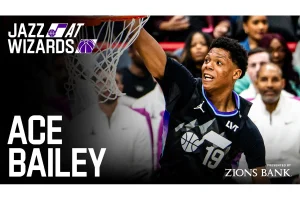
After first-round exits in 2021 and 2022, the Jazz traded Rudy Gobert to the Minnesota Timberwolves on July 1, 2022, and Donovan Mitchell to the Cleveland Cavaliers on September 1, 2022, beginning a new rebuild. Will Hardy was hired as head coach on June 29, 2022. Lauri Markkanen, acquired in the Mitchell trade, was named an NBA All-Star in 2023 and won the NBA Most Improved Player Award for 2022–23. The Jazz posted a 17–65 record in 2024–25, setting a new franchise low, and selected Ace Bailey with the fifth pick in the 2025 NBA draft. On February 3, 2026, the Jazz executed a multi-player trade with the Memphis Grizzlies that brought in Jaren Jackson Jr.
Philosophy and Competitive Strengths
Across eras, the Jazz have built their identity around discipline, ball movement, and strong defensive fundamentals. The Stockton–Malone era made Utah famous for its pick-and-roll execution, while the Gobert–Mitchell era emphasized rim protection and three-point shooting. The current rebuild focuses on length, athleticism, and player development, with Markkanen and a young core positioned as the foundation for long-term contention.
Key Milestones and Major Moments
Major milestones include the franchise’s first playoff appearance in 1984, its first NBA Finals trips in 1997 and 1998, the franchise-best 64–18 record in 1996–97, the launch of the Delta Center era in 1991, the Larry H. Miller ownership takeover in 1986, the 2020–21 NBA-best regular season, and the 2022 teardown that began the post Gobert–Mitchell era.
Utah Jazz Achievements and Results
The Jazz have compiled a strong record of team accomplishments across more than five decades, including two conference championships and 11 division titles. Although the franchise has yet to win an NBA championship, it has remained a consistent playoff presence, particularly during the Stockton–Malone era and again during the Gobert–Mitchell era. Ten jersey numbers, including 1, 4, 7, 9, 12, 14, 32, 35, 53, and 1223, have been retired by the team.
NBA Conference Achievements
The Jazz have won two Western Conference championships, in 1997 and 1998. Both titles came under head coach Jerry Sloan, with Stockton and Malone leading the franchise to back-to-back NBA Finals appearances against the Chicago Bulls. The franchise has also reached the Western Conference Finals on several other occasions, including in 1994, 1996, and 2007, establishing Utah as a perennial Western Conference contender throughout the 1990s and 2000s.
NBA Division Achievements
The Jazz have won 11 division championships, in 1984, 1989, 1992, 1997, 1998, 2000, 2007, 2008, 2017, 2021, and 2022. The franchise’s early division titles reflected its rise from an expansion also-ran to a Western Conference power, while the later titles in 2017, 2021, and 2022 coincided with the Gobert–Mitchell era and the franchise-best 2020–21 regular season that produced the NBA’s top record.
NBA Series Achievements
Over their history, the Jazz have built a tradition of standout individual seasons and the development of major stars. Pete Maravich, Adrian Dantley, John Stockton, Karl Malone, Deron Williams, Donovan Mitchell, and Rudy Gobert each played central roles in defining eras of Jazz basketball. The franchise has produced multiple NBA MVPs, Defensive Players of the Year, All-Stars, and individual award winners, including the 2022–23 NBA Most Improved Player Award won by Lauri Markkanen.