
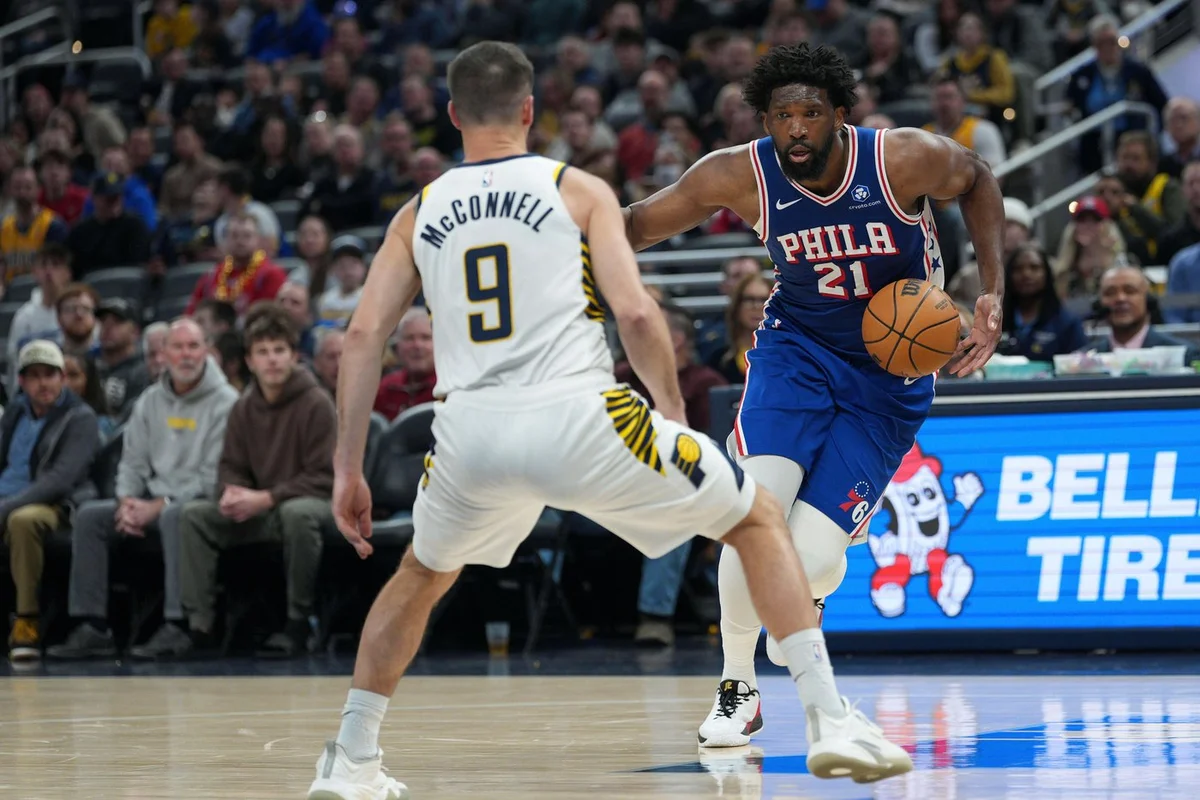
The NBA fantasy basketball landscape is shifting unexpectedly this season, with Indiana Pacers point guard Andrew Nembhard rising as a notable top-50 fantasy option. Following the loss of Tyrese Haliburton to a season-ending Achilles injury, Nembhard’s expanded role has translated into impressive production, making his Andrew Nembhard fantasy outlook an intriguing topic among fantasy basketball managers navigating a volatile season. This surge comes amid a wave of surprising performances and team dynamics unfolding across the league.
Julius Randle’s Surging Fantasy Value Amid Timberwolves’ Playoff Push
Minnesota Timberwolves power forward Julius Randle has quietly climbed the fantasy ranks, staking a claim as a top-10 scorer in fantasy points to date. Though Randle was rarely a first-choice pick on draft day, his consistently efficient output has pushed him ahead of even more hyped teammates like Anthony Edwards. Entering late February, Randle ranks 10th in ESPN fantasy points, surpassing Edwards by 49 points despite Edwards’ status as one of the league’s premier scorers.
Randle’s efficiency is evident: he is averaging 21.9 points, 6.9 rebounds, and a career-high 5.3 assists per game, complemented by 1.1 steals and 1.5 three-pointers made. His shooting percentages have also improved, with a field goal rate near 49% and a career-best free-throw mark above 82%. Durability has been key, as Randle has not missed a game this season, a marked contrast to past years and compared to Edwards’ ten missed games. Despite his underrated profile, Randle is a vital contributor in a Timberwolves squad fighting for playoff seeding.
Helpfully for fantasy managers, Randle remains one of the most affordable high-level options, often undervalued despite his steady fantasy production of nearly 40 fantasy points per game. His steady presence and efficient statistics make him an ideal target for trading or acquiring midseason, especially considering the physical risks surrounding other stars.
Rudy Gobert’s Dominance on the Boards Continues for Minnesota
Timberwolves center Rudy Gobert, returning from a one-game suspension, has reinforced his reputation as one of the NBA’s premier rebounders. In his latest outing against Portland, Gobert grabbed 19 rebounds, pushing his season average to 11.4 boards per game, ranking fourth in the league. Known more for defense and rebounding than scoring—he collects more rebounds than points—Gobert remains a solid fantasy asset despite limited free-throw success.
Gobert’s steady production competes closely with teammate Naz Reid for key fantasy points, underscoring the complex fantasy calculus for Minnesota’s frontcourt. While Gobert’s low free-throw percentage remains a drawback, his overall consistency over the past decade cannot be overlooked by fantasy managers seeking reliable big-man contributions.
Andrew Nembhard’s Unexpected Emergence as a Key Fantasy Contributor
Indiana Pacers point guard Andrew Nembhard has become one of this season’s major fantasy surprises given his rise into the top-50 fantasy list. Initially selected as a late ninth-round pick in ESPN’s average draft position rankings, Nembhard had been viewed primarily as a complementary player. However, with Tyrese Haliburton sidelined after an Achilles injury sustained last postseason, Nembhard was thrust into a starring role.
This expanded responsibility has translated into career highs, with Nembhard averaging 17.4 points and 7.4 assists per game, ranking seventh in the NBA for assists. His fantasy points per game have skyrocketed to 33.7, significantly up from 10 points and 5 assists in previous seasons. While Nembhard may not be receiving widespread consideration for the Most Improved Player award amid peers like Deni Avdija and Jalen Duren, fantasy managers have taken notice, especially those utilizing category-based roto leagues where assists and efficiency hold heavy weight.
Looking ahead, his status presents an intriguing dilemma. If Haliburton recovers and returns to the Pacers’ lineup next season, Nembhard may once again slip to undrafted status in many fantasy leagues simply due to reduced playing time. For now, Nembhard’s rise serves as both a valuable asset and a reminder of the unpredictable opportunities injuries create in fantasy basketball.
Emerging and Established Players Turning Heads in Fantasy Circles
Beyond Nembhard and Minnesota’s key contributors, the fantasy basketball season continues to reveal unexpected stars and evolving roles. Charlotte Hornets point guard LaMelo Ball recently approached his 50th game of the season, surpassing his highest game total since 2021-22. Ball’s durability has improved considerably, missing only 10 of the first 59 contests, which defies earlier durability concerns that pushed managers to draft elsewhere. Ball’s scoring has taken a hit, averaging under 20 points per game, yet his 38.2 fantasy points per game remain valuable when balanced against his availability for potentially 65 or more games.
Another Hornets standout, rookie shooting guard Kon Knueppel, achieved a noteworthy milestone by hitting 200 three-pointers this season, a feat not matched by anyone in the league thus far. His remarkable durability and impressive 43.6% success rate from beyond the arc demonstrate his scoring potential. Experts predict Knueppel could average around 25 points per game next year, placing him in contention as a top-20 fantasy pick. Parallel to Knueppel, Dallas Mavericks’ versatile Cooper Flagg is also projected to have an impactful season, potentially claiming the Rookie of the Year honors.
In Brooklyn, the progress of 6-foot-8 point guard Egor Demin is closely monitored by keeper league managers. Approaching his 20th birthday, Demin displays the skill set to run a team’s offense but currently serves a more limited role with most of his shots coming from three-point range. With the Nets’ highest assist leader being center Nic Claxton at just 4.1 assists per game, the future may hold a larger role for Demin, with possible stat lines resembling 17 points, 6 assists, and over three three-pointers per game. Observers wonder if this points guard profile mirrors that of teams’ traditional playmakers like Payton Pritchard.
Late-Season Returns and Injuries Impact Fantasy Strategy
The New Orleans Pelicans’ Dejounte Murray made a late-February return to action, milking anticipation after missing large chunks of the season. While other notable players such as Trae Young and Ivica Zubac remain sidelined or possibly finished for the year, Murray is actively vying to contribute during a period when many teams are out of playoff contention. Strangely, Murray remains available in over 60% of ESPN leagues, despite last season’s solid averages of 17.5 points, 6.5 rebounds, and 7.4 assists with strong defensive stats. If he continues to play regularly, Murray could prove to be a strong top-50 fantasy investment through the end of the season.
On the injury front, the Utah Jazz suffered a significant blow with center Jusuf Nurkic’s exit due to a nose injury that ended his campaign. Nurkic had been averaging a robust double-double—10.9 points and 10.4 rebounds per game—showcasing value that will be difficult to replace. This situation highlights the frustrating uncertainty that often envelops fantasy managers. Meanwhile, Jazz second-year forward Kyle Filipowski has stepped up, averaging 12.7 points and 8.2 rebounds and being available in about 75% of leagues. Filipowski and point guard Isaiah Collier, both rising players, may surprise teams as valuable contributors during the fantasy playoffs akin to historical underdog success stories.
Analyzing Key Matchups and Trends for Fantasy Managers
The current NBA season is highly unpredictable, with various star players encountering challenges tied to health, team rotations, or role adjustments. Fantasy managers must weigh production versus projected durability when making evaluations. The contrast between Anthony Edwards and Julius Randle illustrates the balance between pure scoring and all-around contribution, with Randle providing a more efficient, well-rounded fantasy profile despite Edwards’ explosive scoring ability.
Similarly, players like Andrew Nembhard epitomize how opportunity created by teammate injuries can transform a roster piece into a vital fantasy asset. Closely tracking such breakout performances is essential for managers seeking edges in large, crowded leagues currently featuring teams tanking or experimenting during the season’s latter stages.
Emerging rookies like Kon Knueppel and Cooper Flagg, combined with developing talents such as Egor Demin, suggest an evolving fantasy landscape shaped by youth and healthy shot creation rather than solely relying on established stars. Managers must remain agile and attentive to roster changes, injuries, and role shifts to capitalize on the chaotic and intense flavor of this NBA season.
