
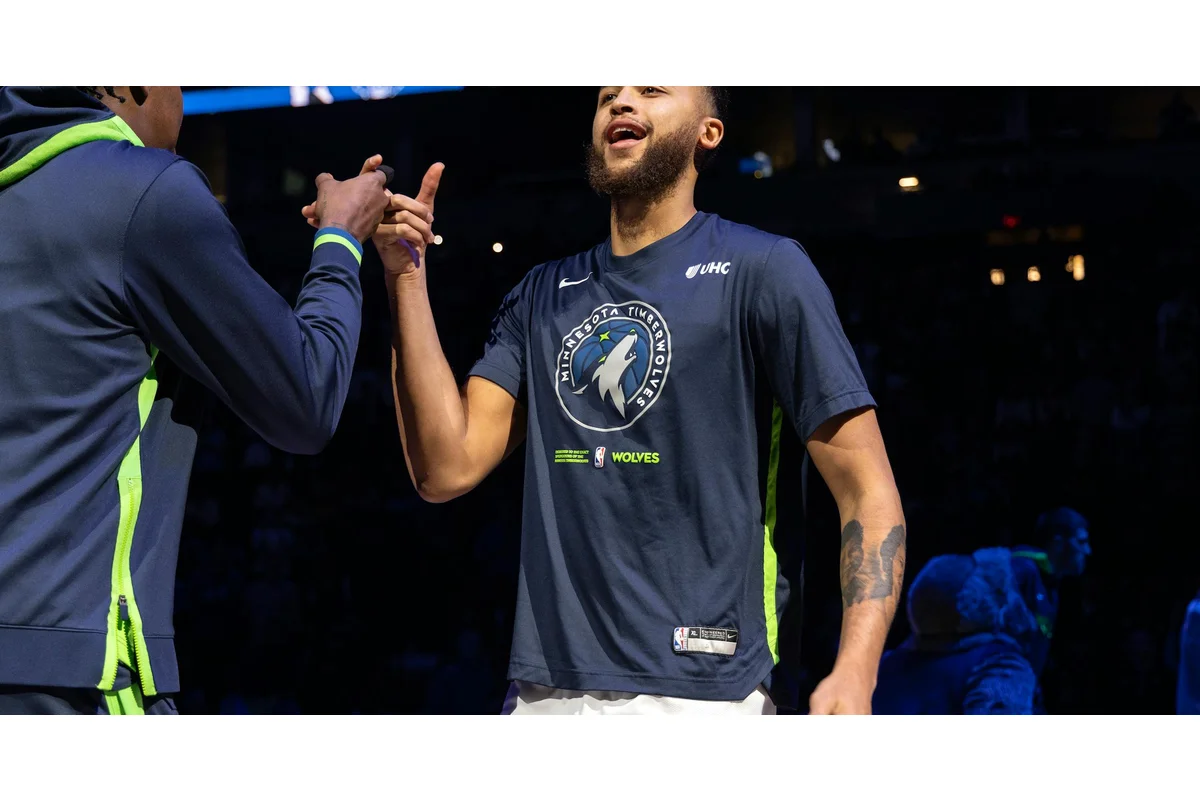
Kyle Anderson’s return to the Minnesota Timberwolves marks a significant moment this season, offering renewed optimism for the team’s postseason ambitions. After seasons of moving between multiple NBA teams, Anderson’s reunion with the Wolves comes at a crucial time, providing a dependable presence off the bench who can create opportunities and contribute to the team’s defensive efforts.
Since first being noted for his performance in Minnesota during the 2022-23 season, Anderson has experienced a complex path, including trades involving the Golden State Warriors, Miami Heat, Utah Jazz, and Memphis Grizzlies. The sequence of moves culminated in his recent return to the Wolves, where he initially made an impact before departing. This homecoming offers the Timberwolves an experienced forward who fits well into their current roster.
Career Transitions and Performance Variations
At 32 years old, Anderson has become one of the NBA’s more well-traveled veterans. His tenure has included 148 games across two Minnesota seasons, followed by shorter stints with Golden State (36 games), Miami (25 games), Utah (2 games), and Memphis (4 games). Despite the frequent moves, Anderson has maintained a consistent level of play, suggesting his skills remain valuable in the right role and environment.
During the 2024-25 season, Anderson’s playing time dropped significantly, averaging just 16.4 minutes per game, the lowest since his early career with San Antonio. Nevertheless, he maintained shooting efficiency, hitting 46.9% of his field goals and 35.7% from beyond the arc, figures consistent with his career averages. Though his 2.4 assists per game declined from the 4.9 assists he recorded in Minnesota the year prior, his assist-to-turnover ratio stayed strong at 3.92, highlighting his reliability on the court.

Rebounding numbers also dipped, averaging 3.4 boards per game, likely affected by reduced minutes. His rebound percentage remained close to his career norm at around 8%, reinforcing his steady contribution in that area. Of particular note, Anderson’s defensive rating stayed impressive, registering 108.2 with Golden State and 106.8 with Miami, both better than the team averages, indicating his positive impact on team defense.
Fit and Role Challenges Across Teams
Anderson’s 2024-25 season with Golden State exposed the challenges of fit in a crowded frontcourt. Sharing the floor with veterans like Draymond Green and Kevon Looney, both limited shooting threats, created offensive spacing issues. Additionally, teammates such as Gary Payton II, known more for defense than shooting, contributed to a congested offense, which negatively impacted Anderson’s offensive rating.
In contrast, Miami’s deeper shooting roster allowed Anderson more space to maneuver. Although he had to adjust to a new role amid a team with comparatively less overall talent, Anderson posted a +5.0 net rating there, a stark improvement over the -6.8 net rating he endured in Golden State. This contrast underscored how critical the right team environment is for Anderson’s success.
Struggles with Utah and Memphis Before Returning Home
This season, Anderson joined the Utah Jazz, a team struggling defensively and poised for a high draft pick due to its poor performance. In 20 games for Utah, he played just over 20 minutes per contest and posted solid shooting percentages—52.3% from the field and an impressive 60% from three-point range, albeit on minimal attempts. His assist-to-turnover ratio remained sound at 3.59, but his overall impact was limited.
Anderson recorded his worst plus-minus of his career at -3.9 per game with Utah and posted a personal worst defensive rating of 116.9, still marginally better than the Jazz’s team defensive rating. These figures reflect the difficulty of producing strong results on a struggling team, suggesting the broader team context significantly influenced his individual performance.
After being traded to the Memphis Grizzlies, Anderson appeared in only four games. During this short span, he improved his net rating to -0.9 from -8.2 in Utah, signifying that even limited opportunities on more competitive teams can help him showcase his strengths. However, the small sample size tempers strong conclusions about his Memphis stint.
Anderson’s Return Offers Stability and Depth for the Wolves
The Timberwolves’ need for a solid rotational forward capable of facilitating offense and providing dependable defense is clear, especially as other potential contributors like Terrence Shannon Jr. face inconsistencies and injuries. Meanwhile, high-upside players such as Bones Hyland show promise but have yet to secure consistent playoff minutes due to performance volatility.
Anderson’s strengths—particularly his exceptional assist-to-turnover ratio and ability to generate plays—address critical gaps for the Wolves. Currently having one of the best shooting seasons of his career, Anderson fits well alongside Minnesota’s primarily shooting-oriented lineup. Notably, Rudy Gobert stands as the only consistent non-shooting player among the Wolves’ top rotation, a familiar teammate for Anderson from previous seasons.
Julius Randle, who occupies a similar position and role, presents a potential minutes challenge, but with Naz Reid and Jaden McDaniels solidifying frontcourt options, Anderson’s role remains valuable without disrupting team balance. His contributions through smart, defense-focused play reinforce his fit as a key bench player.
Implications for Minnesota’s Playoff Push and Beyond
Minnesota sits just one game behind the Denver Nuggets for the third seed in the Western Conference with 22 regular-season games remaining, making Anderson’s return a timely boost. His presence stabilizes the Wolves’ bench rotation and supports a defensive identity critical for playoff success. This reunion also symbolizes a full-circle moment for Anderson—returning to the Timberwolves not as the fresh-faced rookie with his signature Rec Specs, but as a seasoned veteran ready to contribute immediately.
Looking ahead, Anderson’s integration could influence Minnesota’s ability to secure a stronger playoff position and deepen their postseason run. His experience, steady playmaking, and defensive reliability may be the difference-maker as the Wolves navigate a competitive Western Conference stretch run.
