
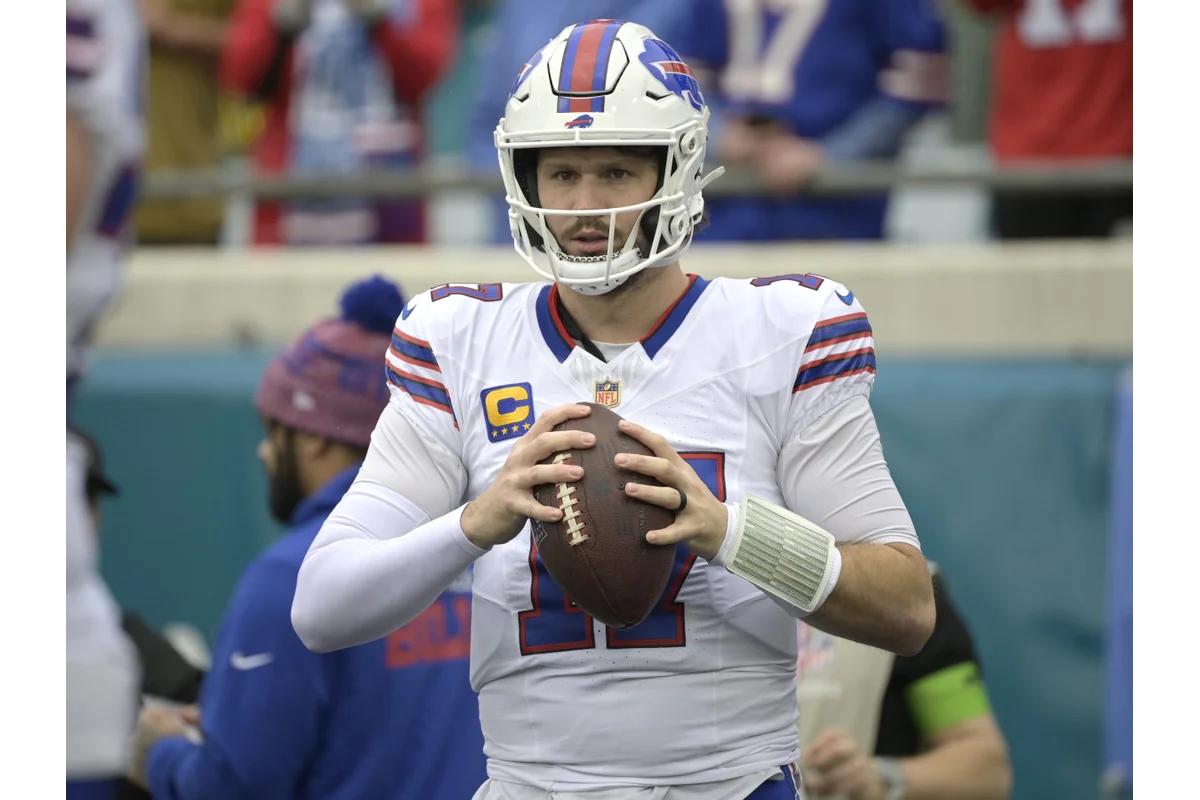
As the 2025 NFL season concludes, the focus now turns to the Buffalo Bills and the challenges awaiting them in the 2026 offseason. Central to all considerations is how the team will adjust under new leadership and navigate important roster and scheme changes to continue their pursuit of playoff success.
Defining the Bills’ New Leadership and Strategic Direction
Joe Brady steps into his first offseason as the Bills’ head coach with an opportunity to imprint his philosophy on a franchise accustomed to stability over the past decade. While many Bills fans are familiar with Brady’s capabilities as an offensive play caller, his full control as head coach means the team’s approach will evolve. Coordinators now take their direction from Brady, who will guide the team’s offseason priorities and weekly game preparations during the 2026 season.
For the first time in ten years, One Bills Drive faces an unpredictable daily routine shaped by Brady’s vision, a challenge he approaches with clear ambitions.
I think it starts with a new energy, a new mentality and a new vision,
Brady said.
A new energy that I’ve got to drive every single day. I believe people are going to feed off that.
Brady outlined the core values he intends to embed within the team culture.

I believe in communication, connection, accountability, love,
Brady stated.
I said to the staff, quiet teams don’t win. Quiet teams do not win. I’m going to do everything in my power to have that communication line open in everything I do. I believe in that. And then love. Connected teams win. If you love the man next to you and you care more about his success than your own, that’s when you’re going to win football games.
Despite this leadership change, Brady is not looking to overhaul a team that has consistently secured playoff berths over the last seven seasons and made postseason advances in six of those years. Yet, he recognizes that past success does not guarantee future results.
We don’t just get to pick up where we left off and think that, ‘Hey, we’re in the position that next week we’re going to be in the conference championship game,’
Brady remarked.
There’s going to be a lot of work. I believe in what Mr. Pegula always says, we’re going to work tirelessly with it. We’re going to have the competitive stamina to start over. But I’m excited about the direction that we have and the people that we have, and I believe in that.
Adjusting the Bills’ Defense to a New Scheme Under Jim Leonhard
Perhaps the most notable on-field transformation in the 2026 offseason will come on defense. With Jim Leonhard taking over as defensive coordinator, Buffalo will adopt a significantly different defensive scheme from what the team has utilized during the past nine years. Rather than discarding previous frameworks wholesale, Leonhard intends to blend continuity with necessary innovation to maximize the roster’s talents.
Leonhard brings firsthand experience adapting to complex defensive systems from his playing days, having operated under coaches like Rex Ryan, Mike Pettine, and Jim O’Neill across four teams and six years in the NFL.
With Rex Ryan in that scheme, Mike Pettine, Jim O’Neill, I was in the system for six years in four different places,
Leonhard explained.
So, to see how it morphed from one place to the next of what you kept, what you changed in terminology, how the personnel dictates how you really set up the game plan. And overall, just the scheme starting in the offseason.
So, as a player, being able to do that through four different phases of my career, that really sparked my interest in coaching where, ‘If I get into coaching, this is what it’s going to look like.’ And I was able to take that straight to Wisconsin and implement it. We want to create a defense that we can all be proud of. A defense that the NFL doesn’t want to play against.
His approach emphasizes flexibility and customization to fit player skill sets and personalities, an important consideration given the existing roster’s makeup.
There is going to be change,
said Leonhard.
It’s been a system that they’ve played in for a long time and just the structure of what they’ve done and how they’ve done it, and why they have done it. It’s going to be a change for them, but we’re excited as a coaching staff to create something that is best for their skill sets and fits their personalities. I am big on flexibility and being able to play to your best players and force offenses to deal with their own problems.
Leonhard’s reputation as a skilled teacher provides optimism that the defense’s transition will be manageable for holdover players.
Managing Salary Cap Issues Amid Growing Financial Demands
In early February, the NFL announced that salary caps for the 2026 season will rise to between $301.2 million and $305.7 million, up by more than $20 million from last year’s $279.2 million limit. This increase offers some relief but does not eliminate the challenges facing Buffalo’s front office as they aim to balance cap compliance with competitive roster building.
Brandon Beane, the Bills’ President of Football Operations and general manager, faces the complex task of structuring contracts and personnel decisions ahead of the new league year commencing March 11th.
We have a lot of work to do this offseason, like we do every year,
Beane said. We’ll have decisions (to make).
Beane has historically leveraged a combination of player releases, contract extensions, restructures, and trades to create salary cap flexibility. With 2026’s heightened cap and roster demands, his adept maneuvering will remain critical.
Evaluating the Impact of a Large Free Agent Pool on the Roster
The 2026 offseason presents an unusual challenge with Buffalo possessing 22 unrestricted free agents and three restricted free agents, a substantial increase compared to the prior year. Combined with shifts in coaching strategy, particularly on defense, this influx will likely drive more roster turnover than recent seasons.
Beane acknowledges multiple factors influencing personnel decisions.
Some of it is going to be dictated by salary cap and guys who are free agents, so they’ll have opportunities to see what their value is and what we can afford within the cap,
Beane explained.
But part of the roster will change because the coaching style changes. That tends to change some personnel things.
Currently, the front office and Joe Brady’s staff are reviewing player evaluations, free agents, and other potential acquisitions to assemble a lineup that fits the evolving team philosophy. Roster building may also benefit from a wider trade market due to coaching changes across the league, including nine teams hiring new head coaches.
A notable example is the Tennessee Titans, who will switch from a 3-4 to a 4-3 defense under new head coach Robert Saleh, the opposite of Buffalo’s transition. Trade opportunities that align players with schemes better suited to their skills may emerge, potentially yielding mutually beneficial moves.
Addressing Deficiencies in Pass Rush and Receiving Positions
Two areas that underperformed during the 2025 season and contributed to the Bills’ inability to advance past the Divisional Round were the pass rush and receiving corps. Buffalo ranked in the league’s lower half for sacks for the second consecutive year, prompting frequent blitzes to generate pressure. Although blitzes produced occasional disruption, consistently sacking opposing quarterbacks remained elusive.
The receiving corps also faced challenges, with significant injuries and inconsistent availability. Aside from Khalil Shakir and Tyrell Shavers, many receivers struggled to stay active, forcing a heavier reliance on the tight ends—Dalton Kincaid and Dawson Knox notably finishing second and third in receiving yards respectively. The three tight ends combined for twelve touchdowns, surpassing the total of eight receivers who had eleven.
Jim Leonhard plans to implement a more aggressive pass rush, drawing on his recent experience with the Denver Broncos, whose defense led the league in sacks over the past two seasons. Yet, he stresses a balance between pressure and discipline.
There’s a right and a wrong way in my opinion on how to attack quarterbacks in the NFL and it changes a little bit week to week based on their skill set,
Leonhard said.
And you have to play to the strengths of your players.
We were able to do it a certain way in Denver. That may not be the way that it looks here, but you have to affect the quarterback. You have to try to change the comfort level of that quarterback. You’ve got to be able to speed him up. You’ve got to be able to slow him down.
On personnel acquisition, Beane and his team will search for players who fit well within Leonhard’s scheme, particularly edge rushers. The 2026 draft is generally regarded by analysts as strong at that position, offering Buffalo an opportunity to strengthen pass rush capabilities affordably with young talent.
Wide receiver improvements are also a priority. Beane’s previous success in acquiring a number one receiver via trade in the 2020 offseason provides a potential blueprint. Last season, the team again pursued a proven top receiver through trade efforts prior to the deadline and remains open to similar moves.
I want number one receivers everywhere, I do,
Beane admitted.
But there were teams out there with number one receivers that haven’t made it as far as we have. Maybe it’s because their O-line isn’t as good. Maybe it’s because they made concessions on defense or other areas. You’ve got to make some concessions. But I promise you, we’re looking. And to the point about the trade deadline when I came in here and we talked about some of the players that we tried to acquire. We’re always trying to acquire them.
While free agency remains an option to bolster the receiving corps, it often requires a premium investment. Given the Bills’ cap constraints, drafting receivers from a class regarded as solid by draft experts may be a more feasible path to upgrading the position.
Outlook: Critical Transitions Set the Stage for Buffalo’s 2026 Campaign
The Buffalo Bills enter the 2026 offseason at a crossroads, marked by a new head coach, significant defensive scheme overhaul, and a large group of free agents. Brandon Beane faces complex salary cap decisions to balance retaining core contributors with upgrading weak spots such as the pass rush and receiving corps. Meanwhile, Joe Brady and Jim Leonhard must integrate their strategies effectively to maintain Buffalo’s competitive edge.
These five overarching questions highlight the intricacies of preparing the franchise for the upcoming season. How well these challenges are navigated could determine whether the Bills can sustain their playoff streak and advance deeper into postseason contention.
GTK our coordinators. 😁 pic.twitter.com/5HGGgMc60b
— Buffalo Bills (@BuffaloBills) February 6, 2026
