
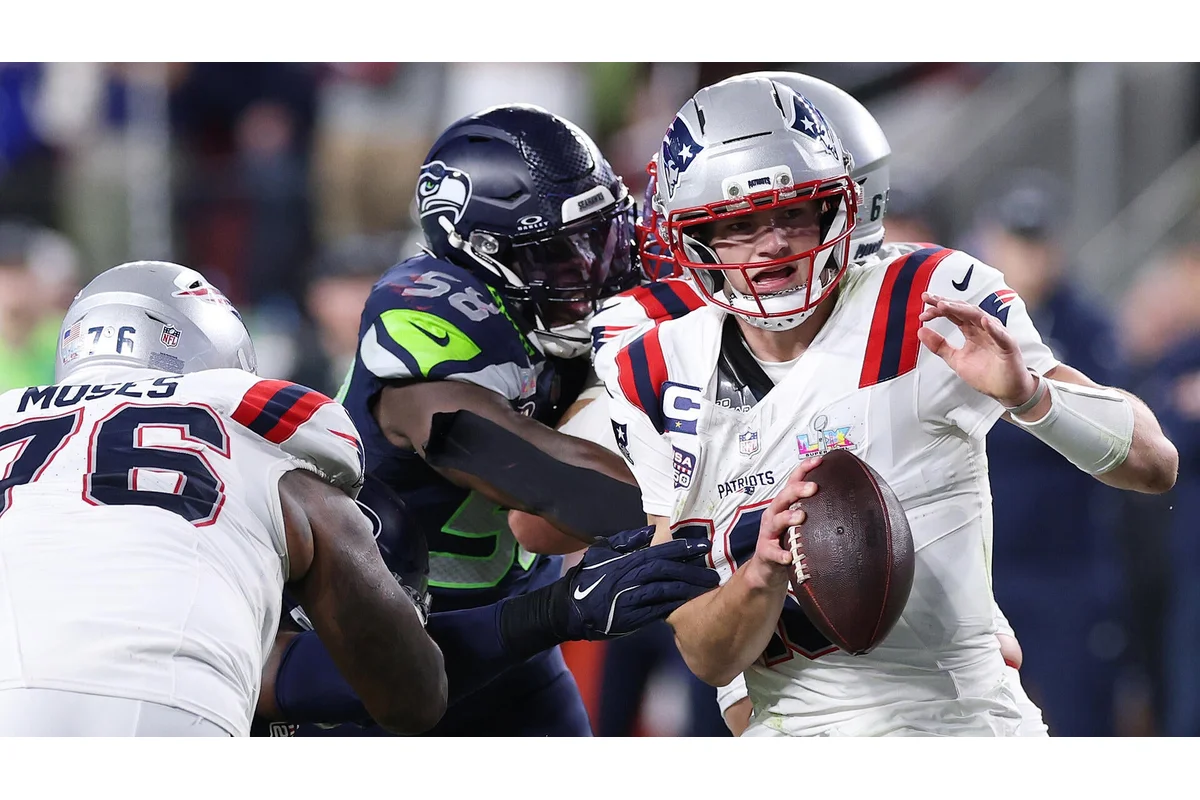
SANTA CLARA, Calif. — Drake Maye experienced a challenging introduction to the Super Bowl stage, suffering a 29-13 defeat at the hands of the Seattle Seahawks on Sunday. At just 23 years old, Maye, the second youngest quarterback to start in a Super Bowl, struggled with three turnovers and was sacked six times while unable to put points on the board for the New England Patriots until the fourth quarter. Despite this rough start, Maye’s future prospects remain hopeful, although history shows that returning to the Super Bowl after an initial loss is a difficult path.
Historical Challenges for Quarterbacks After Losing First Super Bowl
Only a select few quarterbacks have managed to return to the Super Bowl as starters after losing their first appearance, and an even smaller group has claimed victory. Dan Marino, who was 35 days younger than Maye when he started in a Super Bowl following the 1984 season, never made it back after his initial loss to the San Francisco 49ers. Among 36 quarterbacks before Maye who lost their Super Bowl debuts, just seven returned to start another and only four ultimately won the championship.
Jalen Hurts offers a recent example of successful redemption, capturing the Super Bowl title and MVP honors in the 2024 season after losing his first title game two years earlier against Kansas City. Before Hurts, John Elway was the last quarterback to overcome multiple Super Bowl defeats, winning his first championship with Denver in the 1997 season after three previous losses.
Bob Griese also achieved redemption, leading Miami to a perfect 17-0 season and a victory over Washington in the 1972 Super Bowl, following a loss the previous year. Len Dawson is another example; after losing Super Bowl I, he helped Kansas City to win the championship three years later.
However, several quarterbacks returned to multiple Super Bowls but never claimed a title, including Jim Kelly (0-4), Fran Tarkenton (0-3), and Craig Morton (0-2), illustrating how difficult it is to not only get back but also to succeed at the highest level.
Seattle Seahawks’ Defense Dominates Patriots in Title Game
The Seattle Seahawks secured their victory through an imposing defensive performance reminiscent of their 2013 “Legion of Boom” unit and their Super Bowl triumph over Peyton Manning and the Denver Broncos 12 years ago. Advanced metrics such as DVOA rank this year’s Seahawks defense among the top four Super Bowl-winning defenses since 1978, trailing only the 2002 Tampa Bay Buccaneers, the 1985 Chicago Bears, and the 2000 Baltimore Ravens, yet surpassing Seattle’s 2013 championship squad.
Seattle’s defense forced eight punts and one fumble in the game’s first nine New England drives, delaying the Patriots’ first scoring opportunity until 12:27 remained in the fourth quarter. This stands as the fourth longest opening scoreless stretch in Super Bowl history and the longest since the Minnesota Vikings delayed scoring until late in Super Bowl IX.
The Seahawks limited New England to 78 yards over three quarters, the fewest allowed through that span since the 1985 Bears held the Patriots to just 58 yards in Super Bowl XX. Additionally, Seattle became only the fourth team ever to force at least eight punts and three turnovers in a Super Bowl, joining the 2000 Ravens who accomplished this feat against the New York Giants.
Overall, Seattle finished the season with one of the best point differentials—including playoffs—of any Super Bowl champion since 2000, with a 12.3 points per game advantage, slightly trailing the 2013 Seahawks at 12.4. The team lost only three games by a combined nine points, marking a rare instance where a Super Bowl champion was outscored by single digits in its losses, a feat last seen in 1991 by Washington.
Sam Darnold’s Improved Ball Security Fuels Seahawks’ Success
Throughout much of the regular season, Seattle quarterback Sam Darnold struggled with turnovers, leading the NFL with 20. However, beginning with a flawless performance in the Week 18 victory over San Francisco that secured the NFC’s No. 1 seed, Darnold avoided turnovers entirely in his final four games of the season. This clean stretch was crucial in helping him become the first quarterback to win the Super Bowl in a season where he led the league in turnovers since Eli Manning’s 2007 Giants.
Darnold’s care with the football made history as Seattle became the first Super Bowl champion to complete the entire postseason without throwing a single turnover. Only six other teams have come close, losing possession only once during the playoffs, with Kansas City being the most recent in 2022. Seattle’s 28 regular-season turnovers were fewer only than the Denver Broncos’ 31 in 2015 and the Giants’ 34 in 2007 among Super Bowl winners in the 21st century.
Kenneth Walker III Breaks Running Back MVP Drought in Super Bowl
The NFL has increasingly favored quarterbacks when awarding the regular-season MVP, making it exceedingly rare for running backs to receive this honor. Adrian Peterson was the last non-quarterback MVP in 2012, and before Kenneth Walker III’s Super Bowl MVP win, no running back had earned the Super Bowl’s top individual honor in nearly three decades.
Walker rushed for 135 yards—marking the highest Super Bowl rushing total since Terrell Davis’ 157 yards in his 1998 MVP game—and added two receptions for 20 yards. He became the eighth running back to win Super Bowl MVP, tying the number of wide receivers honored in the award’s history. Quarterbacks dominate the accolade with 34 wins, while defensive players have been named MVP nine times, including a shared award in 1977 by Randy White and Harvey Martin of Dallas.
Special teams players rarely receive this recognition; Desmond Howard remains the only one, earning MVP honors 29 years ago for his kickoff return touchdown against New England. Walker joins a rare group of offensive players who have won Super Bowl MVP without throwing touchdown passes or scoring touchdowns themselves, an exclusive list also featuring Joe Namath, Fred Biletnikoff, Deion Branch, and Julian Edelman.
Drake Maye’s Future Hinges on Rare Super Bowl Rebound
Following a difficult Super Bowl debut filled with turnovers and sacks, Drake Maye faces a challenging road ahead should he aim to return and succeed at football’s grandest event. History suggests that rebounding from a first Super Bowl loss as a starting quarterback is not common, emphasizing the rarity and difficulty of such a comeback. Nevertheless, Maye’s youth and potential leave open the possibility of future success, particularly as he learns from this experience.
The dominant Seahawks defense and the flawless postseason execution by Sam Darnold in this game also highlight the level of competition Maye and his team will need to overcome to claim a championship. Meanwhile, the rarity of running backs like Kenneth Walker III earning top honors emphasizes how diverse and evolving the game’s narratives have become on the Super Bowl stage.
As Maye develops over the coming seasons, his journey may follow the footsteps of elite quarterbacks who persevered after initial setbacks, ultimately carving out historic legacies. The challenging history sets a cautious, yet optimistic tone for Maye’s pursuit of a Super Bowl victory and potential redemption on football’s biggest platform.
