

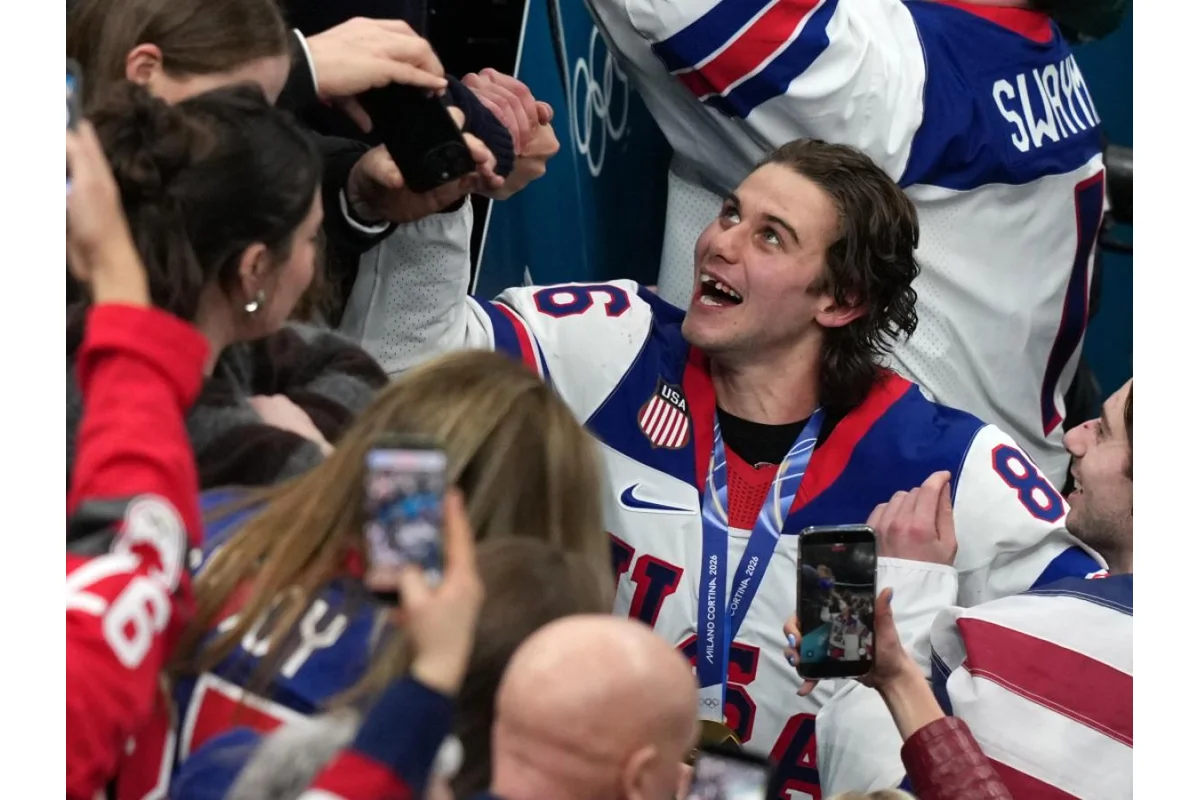
MILAN – Jack Hughes secured the United States‘ first men’s Olympic hockey gold medal in 46 years with a sudden-death overtime goal, edging Canada 2-1 at the 2026 Winter Olympics in Milan Cortina on Sunday. This victory marks the U.S. men’s team’s third Olympic title and their first since the famous “Miracle on Ice” in 1980, coincidentally occurring on the same date as that historic upset over the Soviet Union.
The American team, unlike that original underdog squad composed mainly of college players, came into the Games as a dominant unit built around a roster of NHL veterans and led by standout goalie Connor Hellebuyck, who played a crucial role throughout the unbeaten tournament run.
Key Moments Define a Historic Win Over Canada
The winning goal came early in the overtime period, 1:41 into 3-on-3 play, when Hughes capitalized on a pass from defenseman Zach Werenski during a fast break. The goal sparked jubilant celebrations as the Canadian team looked on from their bench. Following the goal, Werenski and Matthew Tkachuk carried a jersey bearing the No. 13 of Johnny Gaudreau, honoring the beloved player who tragically passed away alongside his brother in 2024. Gaudreau’s family—including his parents Guy and Jay, his widow Meredith, and their oldest children—were in attendance at the game, which also fell just after John Jr.’s second birthday.
Connor Hellebuyck’s Exceptional Performance Anchors Team
Hellebuyck emerged as the tournament’s top goalie, making 41 saves on 42 shots, including several pivotal stops against Canada’s fiercest attackers. His key saves include deflecting a critical third-period shot from Devon Toews and denying Macklin Celebrini on a breakaway shortly thereafter. Hellebuyck’s unwavering defense and the flawless penalty kill, which successfully stopped all 18 opposing attempts, were instrumental in containing the Canadian offense throughout the final.
A Victory that Shifts Long-standing Hockey Dominance
Topping Canada was especially significant given the neighbors’ recent reign over international hockey. Canada had dominated nearly every global competition featuring top players for the last 16 years, including being back-to-back Olympic champions in 2010 and 2014. This win breaks that streak and signals a new chapter for the United States in world hockey.
The gold medal game itself was intense and fast-paced, featuring aggressive physical play and multiple post-whistle confrontations. The U.S. took an early lead with a goal from Matt Boldy six minutes into the game, while Canada’s Cale Makar responded late in the second period to even the score. Still, the Americans held firm, relying heavily on strategic defense and the experience of their tested roster.
Team Composition and Strategic Decisions Fuel Success
The U.S. team’s composition reflected years of talent cultivation through the USA Hockey National Team Development Program, which accounted for 23 of the 25 players. Many players, including team captain Auston Matthews, brothers Jack and Quinn Hughes, Matthew and Brady Tkachuk, and Jack Eichel, had previously played together in various junior and world championship competitions.
This cohesive group overturned skepticism regarding general manager Bill Guerin’s roster choices, which favored experienced players over some of the NHL’s top American goal-scorers who were left off the team. Head coach Mike Sullivan’s decision to entrust the net to Hellebuyck was one widely applauded move that paid major dividends throughout the tournament.
Canada Faces Defeat Despite Strong Effort Without Crosby
Canada, hindered by the absence of injured captain Sidney Crosby, struggled to overcome the Americans. Crosby, a two-time Olympic gold medalist and three-time Stanley Cup winner, was forced to miss the semifinal after leaving the quarterfinal match against Czechia. Connor McDavid, regarded as the best player in the world and captain in Crosby’s absence, experienced another heartbreaking loss, having fallen short of both the Olympic gold and the Stanley Cup Final in recent years against Matthew Tkachuk and the Florida Panthers.
A New Era for U.S. Hockey and Its Global Impact
This victory underscores the United States’ emergence as a consistent force in international hockey, validating years of investment in player development programs and strategic team building. Jack Hughes’ decisive overtime goal against Canada not only ended a decades-long title drought but also challenged the traditional hockey power structure dominated by Canada and other nations.
Looking forward, this accomplishment could inspire confidence within the U.S. hockey community, encouraging the continued growth of young talent and greater competitiveness on the world stage. The win in Milan will likely influence future team selections and coaching strategies aimed at sustaining the U.S.’s newfound status as Olympic champions.
