
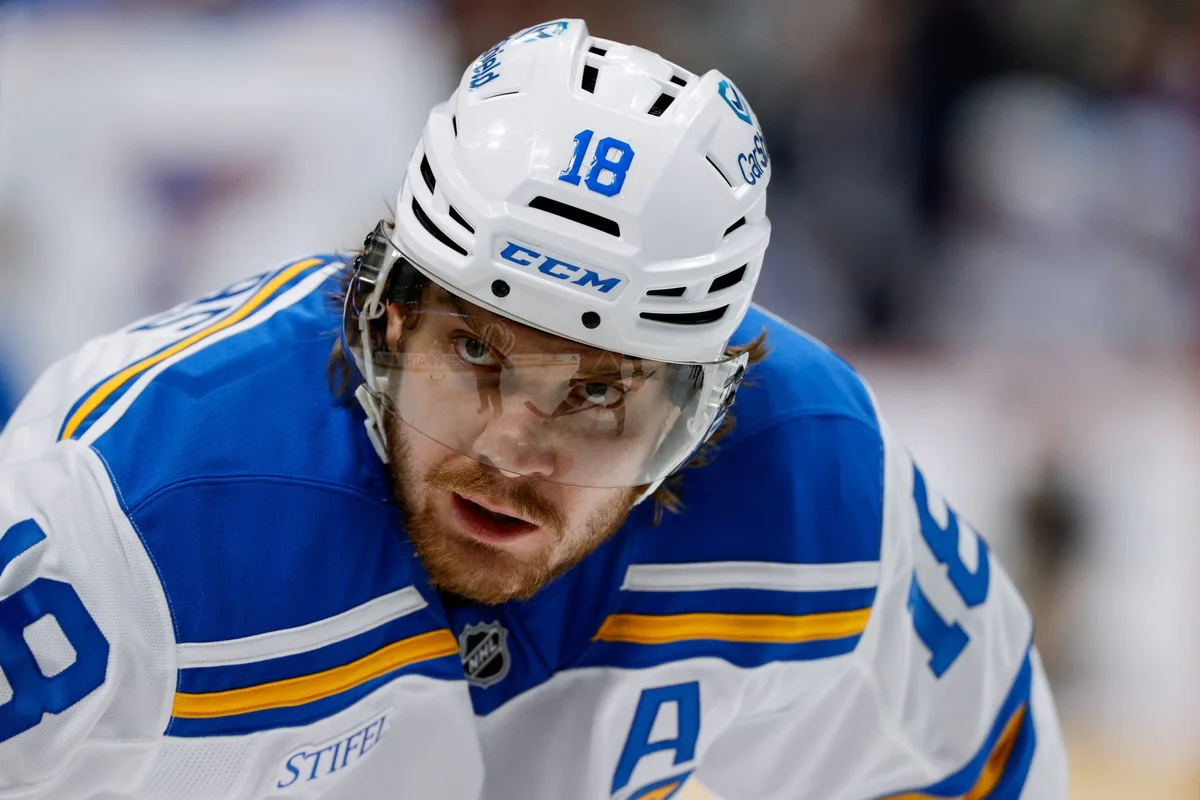
As the NHL trade deadline approaches, the Boston Bruins are contemplating a significant move to add Robert Thomas from the St. Louis Blues, a player who could fill a vital role on their roster both now and for years ahead. However, this potential acquisition would require the Bruins to part with multiple high-value draft picks and blue-chip prospects, forcing general manager Don Sweeney and his staff to carefully balance the immediate benefits with the long-term impact on the team’s future. With the Bruins still holding a playoff spot in the crowded Eastern Conference, the stakes are high as they consider whether the reward justifies the sacrifice involved in a Robert Thomas Bruins trade.
Speaking before the deadline, Bruins GM Don Sweeney emphasized a cautious approach to any roster changes this season.
“We still want to try and complement, supplement our group. The players have done a great job to be in the position they are. We’d like to add to it. We’re going to be a little more cautious than we have for 10 years running in terms of really being aggressive,”
Sweeney stated on NESN.
“But if there are opportunities, we’re going to try to pursue them to improve our hockey club.”
Reasons to Consider Adding Thomas to the Bruins’ Roster
One of the primary advantages of acquiring Thomas is the clear positional need he would fill for Boston, especially beyond the 2026 season. The 26-year-old center is entering his prime and could provide the Bruins with a top-line pivot after a season when the organization previously seemed headed for a prolonged rebuild. Although Thomas may not be at the absolute elite level of stars like Connor McDavid or Nathan MacKinnon, he has demonstrated consistent offensive production, surpassing 80 points in each of the last two NHL seasons.

Thomas’s effectiveness is showcased by his significant playmaking abilities and his increased shooting rates in recent years. Since the beginning of the 2023-24 season, Thomas ranked seventh among NHL players with over 500 minutes of 5-on-5 ice time in assists per 60 minutes, according to Natural Stat Trick. Only superstars such as Nikita Kucherov, Ivan Demidov, and Bruins’ own David Pastrnak outranked him in this category.
His contract situation further enhances his appeal, as Thomas is signed through the end of the 2030-31 season with a manageable $8.125 million annual cap hit, providing Boston with long-term cost certainty on a valuable asset. This aligns with the Bruins’ recent strategy of acquiring established players and securing them with long-term deals, much like their acquisition and contract extension of Hampus Lindholm in 2022.
The addition of Thomas could complement Boston’s promising group of centers including Fraser Minten, James Hagens, and Dean Letourneau, strengthening a core that blends current roster talent with exciting prospects to maintain competitiveness well into the future.
Challenges: The High Price for Acquiring a Top Center
The cost to land Thomas is substantial, given the Bruins’ strong collection of draft picks and emerging young players. Boston boasts four first-round selections across the next two drafts, including Toronto’s 2026 pick which is currently projected at No. 8 overall, albeit with top-five protection. Young contributors such as Fraser Minten and Mason Lohrei already hold roles on the NHL roster, while college stars like James Hagens, who has scored 40 points in 30 games for Boston College, and Dean Letourneau, a 6-foot-7 forward with 34 points in 32 games, are seen as key pieces for the Bruins’ future.
In addition, rookie winger Will Zellers, acquired last March, has shown potential with 17 goals and 27 points in his freshman season at North Dakota. These assets form part of a bright outlook for the Bruins moving forward.
Despite this depth, trading for Thomas would likely require parting with at least two first-round picks and one or more of these prized prospects. Furthermore, salary cap considerations could force Boston to move other players in order to accommodate Thomas’s contract. Blues GM Doug Armstrong is expected to seek significant compensation, which might include NHL-ready players such as Mason Lohrei or Dean Letourneau alongside the high draft picks.
While Thomas could become a cornerstone of Boston’s lineup, the Bruins risk slowing their youth movement that has gained momentum recently, which could affect their pipeline and roster flexibility in the long term.
The Bruins’ Ability to Absorb the Cost Without Derailing Their Future
The prospect of giving up two first-round selections, Letourneau, and Lohrei might initially alarm Bruins fans, given the valuable talent involved. However, the team’s recent rebuilding efforts have provided a wealth of assets, allowing Boston to entertain substantial trade offers without completely draining its pool of young talent.
Even if the Bruins parted with the package rumored to attract St. Louis’s interest, they would retain two first-round picks over the next two years—including the potential for a top-10 selection if the Toronto pick is unavailable—and other elite prospects such as James Hagens. Additionally, players like Minten and Zellers add depth and promise to the roster supporting long-term success.
Therefore, as long as the Blues do not insist on Hagens or the Toronto pick as deal-breakers, Boston has the resources to compete in what is expected to be a heated bidding war for Thomas without sacrificing their entire future.
St. Louis Blues Hold Leverage with No Urgency to Trade
On the flip side, St. Louis is under no immediate pressure to move Thomas before the trade deadline. The Blues, led by former Bruins coach Jim Montgomery, are facing a challenging rebuilding year with a 22-29-9 record, and are likely to focus on trading veteran players like Justin Faulk and Brayden Schenn to regain assets.
Thomas, however, remains a valuable long-term asset under contract, allowing the Blues the luxury of waiting for the right deal instead of selling at a discount. They could choose to hold onto him through the 2026 NHL Draft or until the next season while gauging the market.
If rival teams such as the Bruins or Utah express willingness to meet St. Louis’s high demands—potentially by offering top prospects and multiple draft picks—the Blues may be enticed to finalize a deal. But with all the leverage on their side, they are not compelled to make negotiations easy or quick.
The success of any trade heavily depends on both sides agreeing to terms, and while Boston has strong motives to acquire Thomas, they must be prepared for a challenging negotiation with Doug Armstrong and the Blues’ management.
Implications of a Possible Robert Thomas Acquisition for Boston’s Future
A trade for Robert Thomas would mark a major move for the Boston Bruins, demonstrating their intent to remain immediate contenders while also building toward sustained success. Adding a premier center who excels at playmaking and scoring has the potential to elevate Boston’s offense and help secure a deeper playoff run this season and beyond.
However, the price is high, likely involving several key assets that have been pivotal to the Bruins’ recent youth movement. This forces GM Don Sweeney and the front office to carefully weigh the value of Thomas against the future cost to Boston’s prospect pool and draft capital.
Ultimately, the Bruins face a delicate balancing act: advancing the current roster without jeopardizing the prospects and picks that promise long-term competitiveness. As the trade deadline nears, Boston’s decisions on Robert Thomas will significantly influence the direction of the franchise in the years to come.
If Robert Thomas is available, who should pay up? pic.twitter.com/lRiEcEjhIk
— JFresh (@JFreshHockey) February 6, 2026
Dalibor Dvorsky makes no mistake off the sweet dish from Robert Thomas 🍽️ pic.twitter.com/6bsciKptmM
— NHL (@NHL) November 19, 2025
Hagens finds Jellvik at the back door!
📺 NESN pic.twitter.com/1O3eqe6TJV
— BC Men's Hockey (@BC_MHockey) March 1, 2026
