
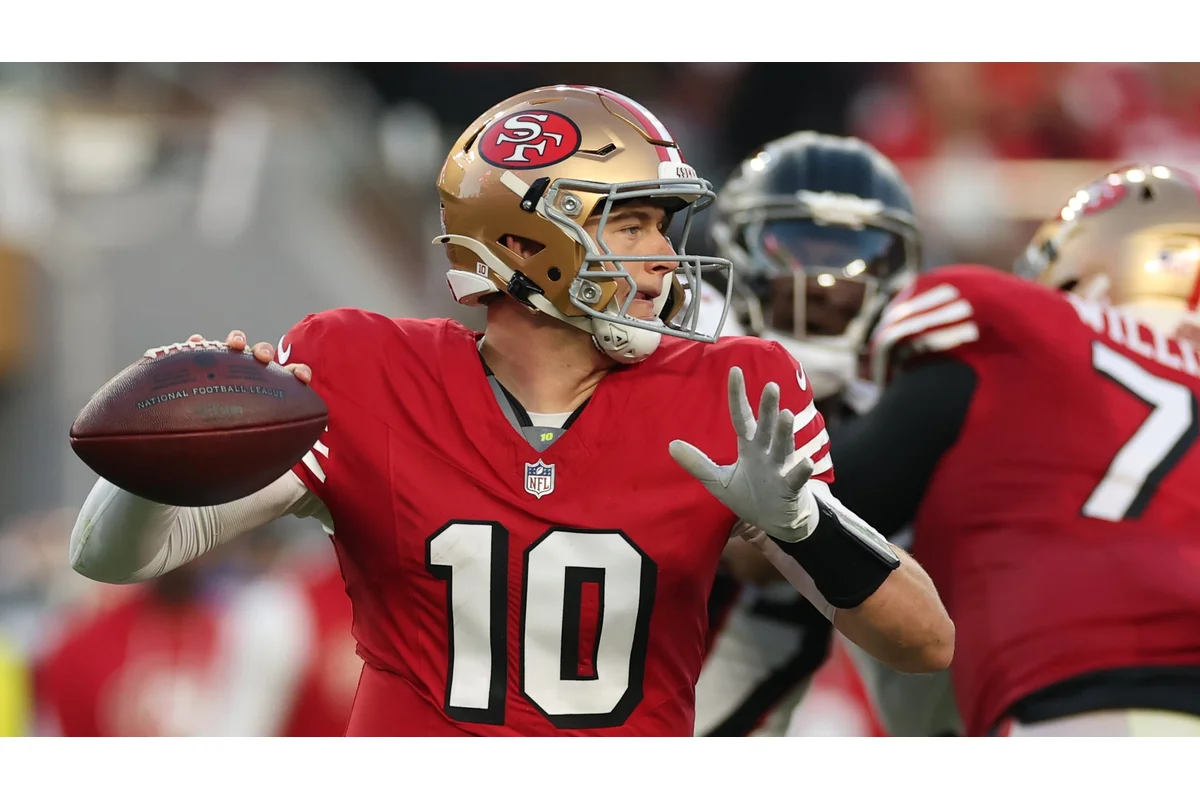
SANTA CLARA, Calif. – The San Francisco 49ers, still mindful of their 2022 NFC Championship Game where they faced a lack of healthy quarterbacks, have emphasized the importance of reliable depth at the quarterback position. Mac Jones’ performance stepping in during the 2025 season when starter Brock Purdy was sidelined reinforced his value, as he guided the team to a 5-3 record with a 62.9 QBR, ranking ninth in the NFL. As the 49ers prepare for 2026, the question of whether Jones will stay as Purdy’s backup or be traded is creating tense uncertainty amid renewed interest leaguewide, focusing attention on Mac Jones’ 49ers future.
Mac Jones’ Impact and the 49ers’ Decision-Making on Retaining Him
Jones’ resurgence has been vital to the 49ers’ late-season push, contributing to both team success and increasing his own market value. General Manager John Lynch praised Jones for his contributions, saying,
“He was outstanding this season. He picked us up in a huge way and it was a really fun process to watch him come in and the joy that he was playing with. He’s got an infectious attitude that affects everybody on our team. It affected that quarterback room … He’s been an outstanding addition.”
Despite this, the possibility of trading Jones remains alive. ESPN reported on February 8 that the 49ers currently plan to keep Jones as the backup quarterback in 2026, with no active intentions to trade him. However, the organization is open to listening to offers if they provide enough value, given Purdy’s injury history and Jones’ solid play during those times.
Coach Kyle Shanahan remarked on the matter after the season, emphasizing the team’s unwillingness to part with key contributors:
“As any player on our team, including myself and John, you always listen to people and trade offers, but we’re also not into getting rid of good players. So, I’d be very surprised if Mac wasn’t around us next year.”
Financial and Contractual Factors Influencing Jones’ Trade Potential
Jones’ contract situation complicates potential trades. For 2026, his base salary is $1.4 million with a cap hit of $3.07 million, a bargain for teams seeking a starting quarterback. Trading Jones would result in $1.792 million in dead money for the 49ers but allow for $1.278 million in cap savings. From a trade value standpoint, acquiring Jones would be an economical solution for teams in need.
However, with Jones likely seeking a contract extension in any trade scenario, teams might hesitate to offer top trade compensation. If Jones remains with San Francisco in 2026, signs of further growth or even limited play could boost his market worth as an unrestricted free agent in 2027. The 49ers could then receive a compensatory third-round draft pick in 2028 as a baseline for considering a future trade rather than an immediate deal.
For context, last year the Las Vegas Raiders acquired Geno Smith, then aged 34, with a 93rd overall pick, a trade likely less valuable than what San Francisco would expect for 27-year-old Jones. The Niners would probably want an earlier second-day draft selection in return.
Interest Across the NFL and Potential Landing Spots for Jones
There is considerable leaguewide interest in Jones, particularly from teams lacking a clear starting quarterback. Potential suitors include the Las Vegas Raiders, Arizona Cardinals, Miami Dolphins, Minnesota Vikings, New York Jets, Cleveland Browns, Pittsburgh Steelers, Indianapolis Colts, and Atlanta Falcons. Many of these NFL franchises face uncertain quarterback situations heading into the offseason.
The Raiders, poised to draft Indiana‘s Fernando Mendoza with the first overall pick, have no other clear quarterback alternatives. Free agency is thin for proven QBs, with few reliable options beyond incumbents like Daniel Jones and Malik Willis, both of whom remain with their current teams or in high demand. Veteran quarterbacks such as Russell Wilson, Marcus Mariota, and Tyrod Taylor are set to enter free agency, while Arizona’s Kyler Murray and Miami’s Tua Tagovailoa could either be traded or released.
Jones’ familiarity with Kyle Shanahan’s offensive system makes him especially attractive to teams like Minnesota, Miami, and Arizona, whose coaching staffs incorporate elements similar to that scheme. This adds complexity to his potential destinations and makes a trade more complicated but still feasible.
Offseason Developments and What Next for Mac Jones
While Jones’ future in San Francisco remains the most likely scenario, his influence grows stronger with each passing offseason. Both the team and the player have had open discussions regarding trade possibilities, ensuring all parties are aware of interests and offers. Coach Shanahan and Lynch have made it clear that trades are only considered with substantial trade value and that Jones’ presence strengthens the roster.
John Lynch echoed the sentiment,
“Like Kyle said, you always listen, but I know we’re a better football team with Mac Jones on our roster.”
Jones himself expressed satisfaction with his time in San Francisco during January interviews:
“I think this year was just awesome for me to be around these guys and the coaches, players, everybody. It was just so fun to get, as I say, the train back on the tracks and that’s what I wanted to do. So put a lot of good film out there… Had a lot of fun and excited for what’s next… I do believe I’m a starter in this league and I’m excited for continuing to get better this offseason and see what happens.”
Should no suitable offers materialize, Jones has made clear he is happy remaining with the 49ers, emphasizing the fit with Shanahan’s system and the team’s culture:
“That’s why I came here knowing that I wanted to be around Kyle and such a great system and knowing that it was a good fit for me, I love the guys here and that would be fun.”
Implications for the 49ers and Broader NFL Quarterback Market
The retention or trade of Mac Jones carries broader implications for the 49ers and the league’s quarterback dynamics. San Francisco benefits from having a reliable backup in Jones, especially given Purdy’s injury history. Trading him could provide valuable draft capital but risks losing a capable quarterback who fits well into their system.
For the NFL, Jones represents an attractive option for multiple teams searching for a competent starter or a bridge quarterback. The quarterback market remains thin, with few proven talents available in free agency or the upcoming draft, raising Jones’ profile as a prime trade candidate. How the situation unfolds will influence offseason moves, draft strategies, and team rebuilding efforts across the league as trade season approaches.
