Edmonton Oilers Overview
The Edmonton Oilers are a professional ice hockey team based in Edmonton, Alberta, Canada. Founded in 1972 as one of the original franchises of the World Hockey Association (WHA), the team joined the National Hockey League (NHL) in 1979 and today competes in the Western Conference’s Pacific Division. The Oilers play their home games at Rogers Place, the 18,641-seat arena that opened in downtown Edmonton in 2016, and are owned by the OEG Inc. group. Their team colors are royal blue, orange, and white, and their mascot is a Canadian lynx named Hunter, introduced in 2016.
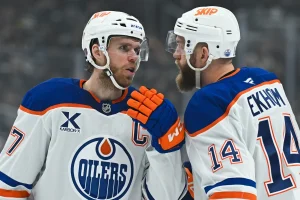
Few franchises in NHL history match the Oilers’ combination of star power and championship success. Edmonton has won five Stanley Cup championships (1983–84, 1984–85, 1986–87, 1987–88, and 1989–90) and has produced some of the greatest players to ever play the game, including Wayne Gretzky, Mark Messier, Jari Kurri, Paul Coffey, and Grant Fuhr. After years of struggle, the franchise returned to the Stanley Cup Final in 2024 and again in 2025, both times facing the Florida Panthers, signaling a modern revival led by captain Connor McDavid and Leon Draisaitl.
Founding and Organizational Origins
The Edmonton Oilers were founded on November 1, 1971 by W. D. “Wild Bill” Hunter and Dr. Charles A. “Chuck” Allard as one of the 12 founding franchises of the upstart World Hockey Association. Hunter, who also owned the Edmonton Oil Kings junior club and had founded the Canadian Major Junior Hockey League, had previously failed in his efforts to bring an NHL expansion franchise to Edmonton and turned to the WHA as an alternative. The original plan called for a second Alberta WHA team in Calgary, but when the Calgary Broncos relocated before the inaugural season, the Edmonton club briefly took the name Alberta Oilers before settling on the Edmonton Oilers for its second year.
The Oilers’ early operations were modest. They played their first WHA games at the historic Edmonton Gardens and were coached in part by Hunter himself, who also served behind the bench during the 1972–73, 1974–75, and 1975–76 seasons. The franchise drew fans with players such as captain Al Hamilton, goaltender Dave Dryden, and forwards Blair MacDonald and Bill Flett, even as the on-ice product remained uneven. In 1976, the franchise changed hands when Hunter and Allard sold the team to Vancouver real-estate developer Nelson Skalbania, who soon brought in local businessman Peter Pocklington as a full partner. Pocklington took over the following year, and a series of shrewd moves set the stage for the team’s rise.
The most consequential of those moves came in 1978, when Pocklington acquired an underage Wayne Gretzky, along with goaltender Eddie Mio and forward Peter Driscoll, from the recently folded Indianapolis Racers. Pocklington also signed Gretzky to a 21-year personal services contract, a decision that would later prove pivotal to the franchise’s future. Glen Sather, acquired as a player in 1976, became player-coach late in that season and soon moved to the bench full-time, beginning a 23-year run as either head coach or general manager of the Oilers.
Growth Into NHL Competition
The Oilers joined the NHL in 1979 as part of the NHL–WHA merger, along with the Hartford Whalers, Quebec Nordiques, and Winnipeg Jets. Of those four absorbed franchises, Edmonton is the only one that has never relocated or been renamed. The Nordiques became the Colorado Avalanche in 1995, the Jets became the Phoenix Coyotes in 1996, and the Whalers became the Carolina Hurricanes in 1997. Upon entering the NHL, the Oilers were placed in the Campbell Conference’s Smythe Division.
The early NHL years were a study in patient team-building. Edmonton missed the playoffs only once in its first 13 NHL seasons, finishing 16th and 14th overall in its first two campaigns while still gaining valuable postseason experience for its young core. The scouting tandem of Glen Sather and chief scout Barry Fraser drafted a remarkable group of future stars within just a few years, including Mark Messier, Glenn Anderson, Jari Kurri, Paul Coffey, Kevin Lowe, Grant Fuhr, and Andy Moog. By 1981–82 the Oilers had finished second overall in the NHL, and by 1982–83 they had reached the Stanley Cup Final, where they were swept by the defending-champion New York Islanders. After that series, Lee Fogolin resigned as captain and Wayne Gretzky was named his successor.
Edmonton Oilers Competitive Journey
The Oilers’ competitive journey is one of the most dramatic in professional sports: a rapid climb to dynasty status in the 1980s, a slow decline through the 1990s, an extended playoff drought through the late 2000s and early 2010s, and a hard-fought return to championship contention in the 2020s. Along the way, the team has won five Stanley Cups, two Presidents’ Trophies, and nine conference championships, while developing an unusually deep pipeline of Hall of Fame talent.
Early Seasons and Development (1979–1983)
The Oilers’ first four NHL seasons were defined by rapid improvement and a steady accumulation of young talent. Gretzky shattered NHL records in 1980–81 with 109 assists and 164 points, while the franchise continued to load up through the draft. In 1981–82, Grant Fuhr emerged as the starting goaltender and set a rookie record by going undefeated in 23 consecutive games, while Gretzky set a single-season NHL record with 92 goals and became the first player in league history to reach 200 points, finishing with 212. That season, the Oilers became the first team to score 400 goals in a year, a feat they matched for five straight seasons, but their playoff run ended in stunning fashion when they blew a 5–0 third-period lead to the Los Angeles Kings in what became known as the Miracle on Manchester.
The 1982–83 season brought the franchise’s first Stanley Cup Final appearance. Gretzky, Messier, Anderson, and Kurri all topped 100 points, with Coffey adding 96, as the Oilers lost only once in the playoffs before being swept by the New York Islanders. The foundations of a dynasty were firmly in place.
Breakthrough in NHL (1983–1990)
The 1983–84 season marked the beginning of the Oilers’ dynasty. Edmonton finished first overall in the NHL with a franchise-record 57 wins and 119 points, becoming the first team ever to feature three 50-goal scorers in Gretzky, Kurri, and Anderson. After sweeping the Winnipeg Jets and defeating the Calgary Flames in seven games, the Oilers dispatched the Minnesota North Stars in the conference finals and then beat the New York Islanders in five games to win their first Stanley Cup. Mark Messier was awarded the Conn Smythe Trophy as playoff MVP.
Edmonton repeated as Stanley Cup champions in 1984–85, finishing with 49 wins and 109 points and defeating the Chicago Blackhawks, Philadelphia Flyers, and others along the way. Gretzky set the playoff record for points in a single year with 47, and the 1984–85 Oilers were later voted the greatest NHL team of all-time during the league’s 2017 centennial celebrations. In 1985–86 the Oilers won the inaugural Presidents’ Trophy with 56 wins and 119 points, but were upset in the second round by the Calgary Flames in a series decided by Steve Smith’s infamous own goal on his birthday.
The 1986–87 Oilers captured their second straight Presidents’ Trophy and returned to the Stanley Cup Final against the Philadelphia Flyers, winning a hard-fought series in seven games. They then won the Cup again in 1987–88, sweeping the Boston Bruins in a series interrupted by the famous Boston Garden power outage. After that championship, Gretzky was traded to the Los Angeles Kings in one of the most stunning transactions in sports history, but the Oilers’ dynasty was not yet finished. In 1989–90, under new head coach John Muckler and behind Messier’s captaincy, the Oilers rallied from a 3–1 series deficit against the Winnipeg Jets, swept the Kings, beat the Chicago Blackhawks, and then defeated the Boston Bruins in five games to win their fifth Stanley Cup. Bill Ranford won the Conn Smythe Trophy, and the Oilers became the first team to win the Cup without Gretzky.
Modern Program and Current Direction (1990–Present)
After the dynasty years the Oilers entered a long period of transition. The early 1990s saw the departures of Grant Fuhr, Glenn Anderson, Steve Smith, Jari Kurri, Charlie Huddy, and Mark Messier, while the team’s poor drafting during the dynasty years left the farm system thin. Edmonton missed the playoffs in 1992–93 for the first time as an NHL team and did not return for four more seasons. A surprise run to the 2006 Stanley Cup Final, fueled by midseason acquisitions such as Chris Pronger, Dwayne Roloson, and Sergei Samsonov, ended in a seven-game loss to the Carolina Hurricanes.
The post-2006 era brought one of the longest playoff droughts in modern North American major professional sports. Edmonton made 16 first-round picks in the NHL Entry Draft from 2007 to 2019, including four first-overall selections: Taylor Hall, Ryan Nugent-Hopkins, Nail Yakupov, and Connor McDavid. The franchise changed ownership in 2008, when Daryl Katz purchased the team from the Edmonton Investors Group, and in 2016 moved into the new Rogers Place. The Oilers returned to the playoffs in 2016–17 behind McDavid’s 100-point season and the Hart Memorial and Art Ross Trophies, and they have since remained a consistent contender. In 2024 the Oilers reached the Stanley Cup Final for the first time since 2006, losing to the Florida Panthers in seven games despite a Conn Smythe Trophy for McDavid. Edmonton returned to the Final in 2025, again falling to Florida, and in 2026 advanced to the playoffs before being eliminated in the first round by the Anaheim Ducks.
Philosophy and Competitive Strengths
The modern Oilers are built around elite offensive talent and high-end skill, with Connor McDavid and Leon Draisaitl forming one of the most productive duos in NHL history. The team’s identity emphasizes speed, transition play, and special-teams excellence, with the power play often serving as the difference-maker in tight playoff games. Defensively, Edmonton has continued to evolve around top-pairing defenseman Darnell Nurse and a supporting cast developed through the draft.
Key Milestones and Major Moments
Among the Oilers’ most significant milestones are their five Stanley Cup championships, two Presidents’ Trophies, six consecutive division titles from 1981–82 to 1986–87, and Gretzky’s seemingly unbreakable offensive records. The franchise hosted the first NHL regular-season outdoor game, the 2003 Heritage Classic, and was involved in the 1988 trade of Gretzky to the Los Angeles Kings, a transaction that fundamentally reshaped the league. In the modern era, Edmonton’s 16-game winning streak in 2023–24, McDavid’s Conn Smythe Trophy in 2024, and back-to-back Stanley Cup Final appearances in 2024 and 2025 have defined a new chapter in team history.
Edmonton Oilers Achievements and Results
Across both the WHA and NHL, the Edmonton Oilers have built one of the most decorated résumés in professional hockey. The franchise has won five Stanley Cups, two Presidents’ Trophies, nine conference championships, and six division titles, while producing 12 Hockey Hall of Fame players and six Hockey Hall of Fame builders.
NHL Achievements
Edmonton’s five Stanley Cup championships came in a remarkable span from 1983–84 to 1989–90, tying the Pittsburgh Penguins for the most titles won by any team since the 1979 NHL–WHA merger. Among all NHL teams, only the Montreal Canadiens have won more Stanley Cups since the 1967 expansion. The Oilers also won the Presidents’ Trophy in 1985–86 and 1986–87, becoming the first team to capture the award in its first two years of existence. Their 1983–84 team set a then-NHL record with 446 goals in a season.
Conference Achievements
The Oilers have won nine Clarence S. Campbell Bowl championships as Western Conference playoff champions, including six during the dynasty era (1982–83, 1983–84, 1984–85, 1986–87, 1987–88, and 1989–90), one during their 2006 run, and two in the modern McDavid era (2023–24 and 2024–25). Their conference titles bookend one of the broadest competitive spans of any NHL franchise, stretching from 1983 to 2025.
Divisional Achievements
Edmonton captured six consecutive Smythe Division titles from 1981–82 through 1986–87, a streak that has never been matched in franchise history. The Oilers have not won a division title since 1986–87, a drought that includes their most recent Stanley Cups and is the longest division-title drought of any North American major professional sports franchise. The 2023–24 team came close, finishing second in the Pacific Division.
Series Achievements
The Oilers have developed two of the NHL’s most compelling modern rivalries. Their long-standing Battle of Alberta with the Calgary Flames has produced multiple dramatic playoff series, including the high-scoring second-round meeting in 2022 that Edmonton won in five games. Their rivalry with the Los Angeles Kings, rooted in 1980s playoff duels and the Gretzky trade, has produced four consecutive first-round playoff matchups from 2022 through 2025, with Edmonton winning all four series and eliminating the Kings each year.