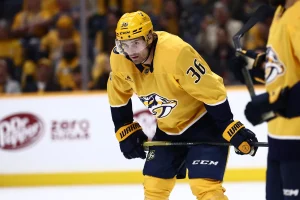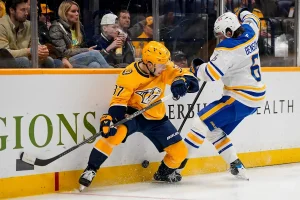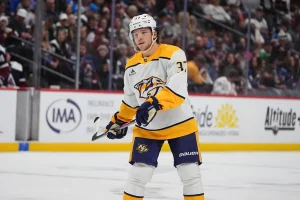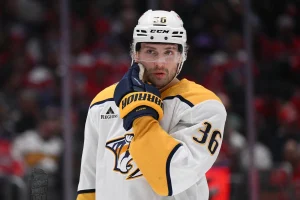
Nashville Predators Overview
The Nashville Predators are a professional ice hockey team based in Nashville, Tennessee, competing in the National Hockey League (NHL) as a member of the Central Division in the Western Conference. Founded in 1998, the franchise plays its home games at Bridgestone Arena and is owned by majority owner Bill Haslam. The team has built a competitive identity around strong defensive play, dependable goaltending, and a passionate fan base that has embraced the “Smashville” culture of playoff hockey.
Across their history, the Nashville Predators have earned one conference championship, two division titles, and one Presidents’ Trophy, with their deepest playoff run coming in 2017 when they reached the Stanley Cup Final. The team is currently led by head coach Andrew Brunette and general manager Chris MacFarland, with captain Roman Josi anchoring the roster. Their official mascot, Gnash, is an anthropomorphic saber-toothed cat.
Founding and Organizational Origins
The path to bringing NHL hockey to Nashville began in late 1995, when rumors surfaced that the New Jersey Devils might relocate to the planned Nashville Arena. When that move failed to materialize, NHL commissioner Gary Bettman indicated that Nashville would likely be considered in future expansion plans. In January 1997, a group led by Wisconsin businessman Craig Leipold made a formal presentation before the league requesting an expansion franchise, and the NHL granted conditional franchises to Nashville, Columbus, Atlanta, and Minneapolis–Saint Paul that June.
Nashville was the only one of the four expansion cities with a completed arena, allowing the franchise to begin play first. The team was required to sell 12,000 season tickets before March 31, 1998, a benchmark they met to lock in their 1998–99 debut. On July 9, 1997, Leipold named former Washington Capitals general manager David Poile as the franchise’s first general manager, and on August 6, Portland Pirates head coach Barry Trotz was named the team’s first head coach. The franchise’s logo, a saber-toothed cat, was unveiled on September 25, 1997, referencing a partial Smilodon fossil discovered beneath downtown Nashville in 1971.
On November 13, 1997, Leipold announced that the franchise would be known as the Nashville Predators, a name he personally submitted to a fan vote that included “Ice Tigers,” “Fury,” and “Attack.” The city of Nashville paid 31.5% of the $80 million expansion fee and agreed to protections against annual arena operating losses above approximately $3.8 million.
Growth Into NHL Competition
The Nashville Predators took the ice for the first time on October 10, 1998, losing 1–0 at home to the Florida Panthers, and earned their first win three nights later against the Carolina Hurricanes. Their early rosters were built largely through the 1998 NHL expansion draft, where protected lists limited their options, and through the entry draft, where selections like Shea Weber and Ryan Suter began shaping the long-term core of the organization.
The team’s first postseason appearance came in 2003–04, when an eighth-place finish in the Western Conference earned them a first-round matchup with the Detroit Red Wings. Although the Predators were eliminated in six games, the playoff berth marked a significant step in establishing the franchise as a competitive NHL market. The following 2004–05 season was canceled due to a league-wide labor dispute, but the franchise used the reset to continue building its infrastructure and player development pipeline through affiliates in the American Hockey League and ECHL.
Nashville Predators Competitive Journey
The Nashville Predators’ competitive journey has unfolded in clear phases: an early development period marked by gradual improvement, a sustained run of playoff appearances that produced the franchise’s deepest postseason results, and a more recent period of transition and retooling under new leadership.
Early Seasons and Development (1998–2014)
The Predators’ inaugural 1998–99 season ended with a 28–47–7 record, placing them second-to-last in the Western Conference, and the 1999–2000 campaign finished with a similar mark at the bottom of the conference. The team opened the 2000–01 season with two games against the Pittsburgh Penguins at the Saitama Super Arena in Tokyo, drawing the largest crowds ever to witness a hockey game in Japan. By December 6, 2001, the Predators had recorded their 100th franchise victory, and the 2003 draft added foundational players Shea Weber and Ryan Suter to the organization.
The post-lockout era brought the signing of free agent Paul Kariya and an 8–0 start to the 2005–06 season, a pace matched by only three other NHL franchises in history. After accumulating 106 points and clinching home-ice advantage for the first time, the Predators were eliminated by the San Jose Sharks in the first round. Subsequent seasons saw the franchise invest heavily in stars like Jason Arnott and Peter Forsberg, while a 2007 ownership crisis threatened relocation before a local group led by David Freeman completed a purchase agreement with Mayor Karl Dean and the NHL Board of Governors approved the sale on November 29, 2007.
Breakthrough in NHL (2005–2020)
The Peter Laviolette era, beginning in 2014, ushered in the most successful period in Nashville Predators history. The 2016 offseason featured a blockbuster trade of captain Shea Weber to the Montreal Canadiens for defenseman P. K. Subban, and Mike Fisher was named the franchise’s sixth captain on September 7, 2016. In the 2016–17 season, the Predators swept the Chicago Blackhawks in the first round, becoming the first eighth seed in NHL history to sweep a top seed in a best-of-seven series, and then defeated the St. Louis Blues and Anaheim Ducks to reach the 2017 Stanley Cup Final.
The 2017 Stanley Cup Final saw the Predators fall behind 2–0 to the Pittsburgh Penguins before tying the series with home wins in games three and four, ultimately losing in six games. The following 2017–18 campaign produced the franchise’s first Presidents’ Trophy and first Central Division title, with Pekka Rinne winning the Vezina Trophy as the league’s top goaltender. Nashville captured a second consecutive division title in 2018–19, while the team played in its first outdoor game at the 2020 Winter Classic at the Cotton Bowl against the Dallas Stars.
Modern Program and Current Direction (2020–Present)
John Hynes was hired as the third head coach in franchise history on January 7, 2020, and in his debut behind the bench Pekka Rinne became the second Nashville goaltender to score a goal. After a qualifying-round loss to the Arizona Coyotes in the 2020 expanded playoffs and a first-round exit to the Carolina Hurricanes in 2021, Rinne announced his retirement as the franchise’s all-time leader in wins and games played. The Predators hosted the 2022 Stadium Series at Nissan Stadium, losing 3–2 to the Tampa Bay Lightning.
On June 17, 2022, former Governor of Tennessee Bill Haslam began purchasing shares in the club to become the majority owner. In February 2023, David Poile announced his retirement as general manager, with former head coach Barry Trotz named as his successor effective June 30, 2023. The Predators hired Andrew Brunette as the fourth head coach in franchise history on May 31, 2023, and on June 2, 2026, Colorado Avalanche general manager Chris MacFarland was named Trotz’s successor, joining Nashville as president of hockey operations and general manager.
Philosophy and Competitive Strengths
The Nashville Predators have long built their identity around a structured defensive system, elite goaltending, and a physical forechecking style. The franchise has developed top defensemen through the draft and trade markets, while power play execution and depth scoring have frequently been areas of organizational focus as the team has sought to convert regular-season success into deeper playoff runs.
Key Milestones and Major Moments
Key milestones in Nashville Predators history include the franchise’s first victory on October 13, 1998, the first playoff appearance in 2003–04, the 2017 sweep of the Chicago Blackhawks as the first eighth seed to topple a top seed in a best-of-seven series, the 2017 Stanley Cup Final appearance, the franchise’s first Presidents’ Trophy and division title in 2017–18, and the 2020 Winter Classic at the Cotton Bowl.
Nashville Predators Achievements and Results
The Nashville Predators have compiled a competitive resume that includes one Presidents’ Trophy, one Clarence S. Campbell Bowl as Western Conference champions, and two Central Division championships. While the franchise has yet to capture the Stanley Cup, its postseason results include a Stanley Cup Final appearance and multiple deep runs that have established Nashville as a respected NHL market.
NHL Achievements
At the league level, the Nashville Predators captured their first Presidents’ Trophy in 2017–18, recognizing the best regular-season record in the NHL. Pekka Rinne won the Vezina Trophy as the league’s top goaltender that same season, and Roman Josi has earned individual recognition as one of the premier defensemen in the NHL. The franchise’s 2017 run to the Stanley Cup Final remains the defining achievement in club history.
Conference Achievements
The Nashville Predators won the Clarence S. Campbell Bowl as Western Conference champions in 2016–17, defeating the St. Louis Blues and Anaheim Ducks in the conference playoffs before facing the Pittsburgh Penguins in the Final. The franchise has returned to the conference semifinals on multiple occasions, including a 2011–12 appearance and a 2017–18 second-round matchup with the Winnipeg Jets.
Divisional Achievements
The Nashville Predators have won the Central Division title twice, in 2017–18 and 2018–19, with the back-to-back championships marking the high point of the team’s divisional performance. These titles helped establish Nashville as a consistent Central Division contender and seeded the team favorably in multiple playoff brackets.
Series Achievements
Within the Western Conference playoff picture, the Nashville Predators have produced several standout series, including a six-game defeat of the Anaheim Ducks in the 2011 playoffs, the historic sweep of the Chicago Blackhawks in 2017, and series victories over the Colorado Avalanche in 2018 and the Carolina Hurricanes in 2021. The franchise’s first-round victory over the Detroit Red Wings in 2012 and a 2023–24 wildcard qualification that ended against the Vancouver Canucks in six games reflect the team’s continued presence in the postseason picture.